
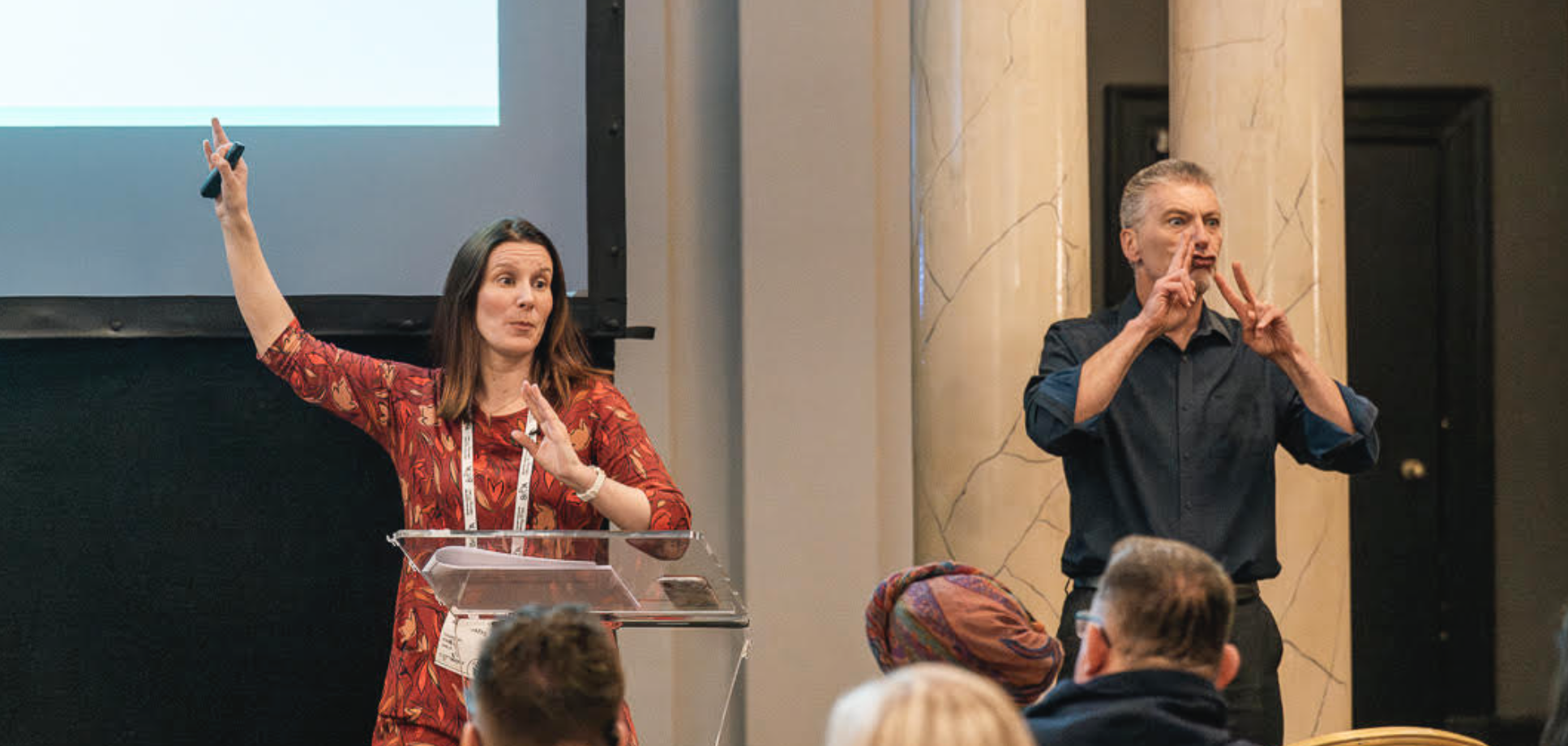
Last week I had the privilege of presenting at the BDA BSL Conference 2025. The theme was ‘Us. Here. Always’ and the conference marked 135 years of the BDA campaigning for and safeguarding the rights of deaf, signing communities in the UK.
My presentation focused on the academic, emotional and linguistic benefits of sign bilingualism for schools.
In my presentation I asked delegates to imagine a world where deaf babies received equal access to language right from the start. I asked them to imagine parents being given access to sign language support right at the point of diagnosis. When parents receive the news in the hospital that their child has ‘passed the deaf test’ at the newborn hearing screening this can often be a difficult and overwhelming time that is dominated by a medical model of deafness. I asked delegates to imagine if in the early days parents were also introduced to a sign language coach, a Deaf person with excellent BSL skills who would act as a tutor, guide and mentor for the family. I asked them to imagine the difference it could make if parents were given a language pack, alongside all the medical leaflets. The language pack could contain BSL flashcards, QR codes for a BSL learning app, a voucher for family sign language classes and an invitation to attend the local Deaf Hub. Imagine the difference it might make to feel included in a language community, right from the start! Learning a new language is a daunting experience but with funding and support it might feel more achievable for hearing parents. Gem Fountain and Mhairi Simpson, in their presentation at the BDA conference on the Family Sign Language project, explained the importance of getting the right support early on.

In my presentation I argued that we are at a crossroads in deaf education where we can see two futures unfolding, a bit like the nineties film Sliding Doors with Gwyneth Paltrow. One pathway follows the future of hearing technology only and the other pathway includes early access to BSL alongside the benefits of improvements in technology. New research is revealing that with early access to BSL deaf children can meet language milestones, can close the academic achievement gap and can feel emotionally secure at school and at home. But which future will we see unfolding? Dr. Katie Rogers and Dr. Kate Rowley, in their presentation at the BDA conference, presented compelling evidence that deaf children must have early access to BSL.

So, given there are so many benefits, academic, emotional and linguistic, of deaf children having early access to BSL, how can we encourage schools to sign more? In my presentation I argued that we need to increase services for families to learn sign language. The BDA (2024) have argued that currently 53% of services in the UK neither provide, fund or commission opportunities for families to learn sign language. This is not good enough and underlines the urgency of BDA campaigns like ‘BSL in our Hands’.
Another step we can take to encourage schools to sign more is to nurture Deaf community spaces. It was a privilege to visit Leeds Society for Deaf and Blind People as part of the conference and learn about the difference it has been making in deaf peoples’ lives over the decades. Sadly, traditional deaf clubs are becoming rare nowadays, so we need to find ways to enable deaf children to meet each other, hearing parents to meet Deaf adults and learn sign language, older deaf people to socialise and overall to create spaces that safeguard Deaf culture.
It is exciting to see that some schools for deaf children, like the Deaf Academy where I have recently become a governor, are transforming into deaf-friendly, deaf-led spaces. It was great to connect with leaders from Frank Barnes School for Deaf Children and the Royal School for the Deaf Derby at the conference and hear more about the important work they are doing.
So, thinking back to the crossroads we find ourselves at, which future do you think we will see? Will it be the pathway of hearing technology only, even though the research has repeatedly shown that this disadvantages deaf children? Or will we be able to enact a change that enables deaf children to gain early access to sign language and all the benefits that that will bring?
At the end of my presentation, an older member of the Deaf community stood up, with support from her grandson, and expressed her anger that after so many years, so little had changed for deaf children. Let’s hope that the new research that is emerging about the benefits of sign language, is finally able to make lasting change.
If you would like to read the full academic study that Hannah’s presentation was based on, here is a link (a BSL summary is available if you scroll down the page below the main paragraph of text):
https://bera-journals.onlinelibrary.wiley.com/doi/full/10.1002/rev3.70016
Dr. Hannah Anglin-Jaffe is a Senior Lecturer at the University of Exeter. Her research focuses on deaf education and sign language. She is hearing but is learning BSL. She is also a governor at the Deaf Academy. You can contact her on h.a.anglin-jaffe@exeter.ac.uk.
Photographs by Charlie Swinbourne.
Enjoying our eggs? Support The Limping Chicken:

The Limping Chicken is the world's most popular Deaf blog, and is edited by Deaf writer and photographer Charlie Swinbourne.
Our posts represent the opinions of blog authors, they do not represent the site's views or those of the site's editor. Posting a blog does not imply agreement with a blog's content. Read our disclaimer here and read our privacy policy here.
Find out how to write for us by clicking here, and how to follow us by clicking here.
This site exists thanks to our supporters. Check them out below:
- Lumo TV: TV programmes in BSL for the Deaf community
- Bellman & Symfon: home alerting solutions, including the mobile phone transceiver!
- SignVideo: Instant BSL video interpreting online
- British Deaf Association: Working to transform the way BSL is accessed in the UK
- 999 BSL: call 999 in an emergency, in BSL
- Deaf Umbrella: Making colleges and workplaces more accessible
- Appa: Looking for RSLIs, TSLIs and CSWs, apply here!
- Signly: Adding BSL to websites
- Signworld: Learn BSL online!
- DCAL: world-class research into deafness, cognition and language
- Lipspeaker UK: specialist lipspeaking support
- BID: Deaf services, including advice and support, interpreting, employment and letters
- Interpreting Matters: BSL interpreting agency
- Sign Solutions: Instant access to Interpreters, training and BSL translation nationwide
- InterpretersLive: On demand BSL video interpretation
- Performance Interpreting: BSL interpreting at concerts
- National Deaf Children's Society: The leading charity for deaf children
- Action Deafness: “A Deaf-Led Charity” – interpreting & community support services




Posted on July 24, 2025 by Editor