
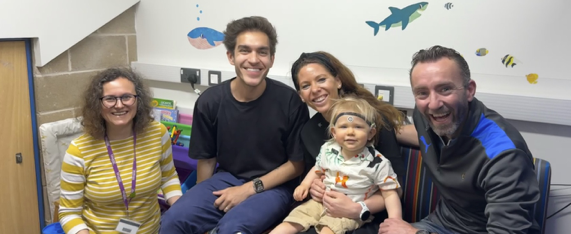
[Photo: Professor Teodora Gliga and Research Associate Eryk Mejia with a family with a deaf infant in the play area of Babywaves]
When encountering an animal that we recognize as a dog, we immediately think of its category label—“dog”— and understand that it may bark or enjoy playing fetch without needing to experience this directly, every time we encounter a new dog. Every day, our mind groups things that look similar together without us having to think about it.
Babies do not immediately have this privilege at the level adults do, but over their first years of life, they are developing this skill. Possibly, babies may use knowledge of categories as the building blocks for language to put the puzzle pieces together. For example, in babies, some studies have demonstrated that infants learn object categories much faster when members of that category are given a label (i.e., a parent says/signs “dog” when encountering dogs) compared to simply noticing what the objects all have in common (e.g., fur coat, four legs).
However, for deaf babies, this experience may be different. Most deaf babies are born to hearing parents (as much as 95% in the United Kingdom) and few are born to Deaf parents. This means that rich access to language — which is needed for labelling — is scattered for many of these children. In fact, for most hearing parents, their deaf baby is the very first deaf person they will get to know.
In many cases, deaf babies are likely to experience some degree of language deprivation due to reduced access to any form of language (visual or spoken) within the first year of life. While this can be addressed to some extent through the use of hearing aids/cochlear implants or through caregivers using sign language, this long period of limited language access may have effects on their later cognitive development. Why is this?
Firstly, it takes time to learn a language — most hearing parents are not equipped with existing knowledge of a sign language from the start of their baby’s life, and many will be juggling learning sign language alongside their busy lives as a parent caring for a young child. Secondly, current advances in technology and healthcare policies allow cochlear implantation at a minimum of twelve months of age. As language experience in the first year of life is crucial, this may not be early enough for some babies. On average, most deaf infants receive their cochlear implants around sixteen months of age. This creates a gap of time where access to language can be variable, leading to less-than-ideal outcomes in category learning, a foundational cognitive skill.
The Deaf identity of the parent also plays a significant role in their deaf baby’s language access. Although they represent a small number of the wider demographic of deaf babies, Deaf parents can provide important insights into how language access affects category learning. With most of them already having first-hand knowledge about sign language and the Deaf experience, Deaf parents’ interactions with their deaf babies and their teaching methods regarding categories differ from those of hearing parents of deaf babies.
As a deaf person of hearing parents, I can relate to the challenges that these families face when learning how to best support their baby. Being in my mid-twenties now, the attitudes surrounding sign language usage was negative when I was a child, and cochlear implants were still seen as new and cutting-edge. I received my first implant when I was seven and learned sign language when I was fourteen – at the time, this was no small feat for me and my family to accomplish. I am thankful of my experiences for teaching me important lessons in resilience and community-building.
Nowadays, sentiments and technology are changing. Sign language is becoming accessible, and research has evidence to support it as a “real” language, eradicating any stigma about its validity. An indirect result of this is that more people are able to access quality sign language learning resources, allowing Deaf and hearing people to learn and use it freely, particularly in communication with deaf babies. Cochlear implantation has advanced, allowing for the procedure to be done earlier and earlier. Therefore, with the tools and knowledge that have become available to us now, I believe it has become more important than ever to peel back the curtain and understand the importance of language access to cognitive development, particularly in category learning.
At the University of East Anglia in Norwich, the Baby Language and Conceptual Knowledge Study (BLoCKS) was launched precisely to take a closer look at this topic. We asked ourselves: how do babies understand and organize the world around them – even if they haven’t been able to access language consistently? Which other ways, besides language, can parents use to help deaf babies make sense of what they see and experience? How does full access to fluent sign language from Deaf parents help deaf infants learn about the world around them?
I joined the BLoCKS project in mid-2023 to answer these questions and provide important insight into the role that language experiences play in early cognitive development. To be clear, this project is not about the impact of deafness itself, but of language access difficulties that sometimes comes with deafness. For this reason, we highly value the experiences of both Deaf families with deaf babies and hearing families with deaf babies due to their varying language experiences. If language access is shown to be crucial for category learning, we can advocate for wider access to language, especially in the UK context where British Sign Language has only just been recognized as a language. Professor Teodora Gliga, lead researcher of BLoCKS, highlights why this matter is worth exploring:
“Understanding to what extent [language] may be needed for acquiring category knowledge…is an urgent matter for populations with reduced access to language, such as for deaf infants born to hearing families.”
To achieve our goals, we founded a cutting-edge infant lab, Babywaves, a first-of-its-kind for the University of East Anglia. Our setup has been carefully designed with babies in mind to make taking part in our studies a fun and exciting experience for families. Alongside our baby play area filled with toys and games, we have exciting techniques we use to figure out the object categories babies recognize early in life. For example, we use electroencephalography (EEG) which is a baby-friendly technique for measuring brain activity while they see pictures of objects and eye-tracking cameras which can follow where a baby looks on a screen.
This study would not be possible without the support and awareness of our Deaf and hearing families. Their participation goes a long way to helping deaf children achieve the best possible outcomes, such as myself. The BLoCKS team is prepared and ready to invite parents, Deaf or hearing, with a deaf child, for a family getaway to the historic city of Norwich. They will have the opportunity for leisure time in the city and participate in fun activities at Babywaves, and all travel expenses will be covered. To find out more about what participating looks like, check out our clipped YouTube video (click here) of a family taking part. If you or someone else you may know with a deaf baby would be interested in taking part in this study or want to know more, feel free to reach out to us for a chat—we’ve included our contact details in the flyer below, or you can email child.scientist@uea.ac.uk.

This four-year study is currently underway and has the support and funding of the UK Economic and Social Research Council. The project is set to wrap up in 2028 and the first findings are expected to be published in academic journals following its conclusion.
My name is Eryk Mejia and I am a Deaf cognitive development researcher and current physician-in-training.
Enjoying our eggs? Support The Limping Chicken:

The Limping Chicken is the world's most popular Deaf blog, and is edited by Deaf writer and photographer Charlie Swinbourne.
Our posts represent the opinions of blog authors, they do not represent the site's views or those of the site's editor. Posting a blog does not imply agreement with a blog's content. Read our disclaimer here and read our privacy policy here.
Find out how to write for us by clicking here, and how to follow us by clicking here.
This site exists thanks to our supporters. Check them out below:
- Lumo TV: TV programmes in BSL for the Deaf community
- Bellman & Symfon: home alerting solutions, including the mobile phone transceiver!
- SignVideo: Instant BSL video interpreting online
- British Deaf Association: Working to transform the way BSL is accessed in the UK
- 999 BSL: call 999 in an emergency, in BSL
- Deaf Umbrella: Making colleges and workplaces more accessible
- Appa: Looking for RSLIs, TSLIs and CSWs, apply here!
- Signly: Adding BSL to websites
- Signworld: Learn BSL online!
- DCAL: world-class research into deafness, cognition and language
- Lipspeaker UK: specialist lipspeaking support
- BID: Deaf services, including advice and support, interpreting, employment and letters
- Interpreting Matters: BSL interpreting agency
- Sign Solutions: Instant access to Interpreters, training and BSL translation nationwide
- InterpretersLive: On demand BSL video interpretation
- Performance Interpreting: BSL interpreting at concerts
- National Deaf Children's Society: The leading charity for deaf children
- Action Deafness: “A Deaf-Led Charity” – interpreting & community support services




Posted on October 3, 2025 by Editor