
Limping Chicken are sharing a range of lay summaries for research by DCAL (Deafness Cognition and Language Centre), here is the first post:
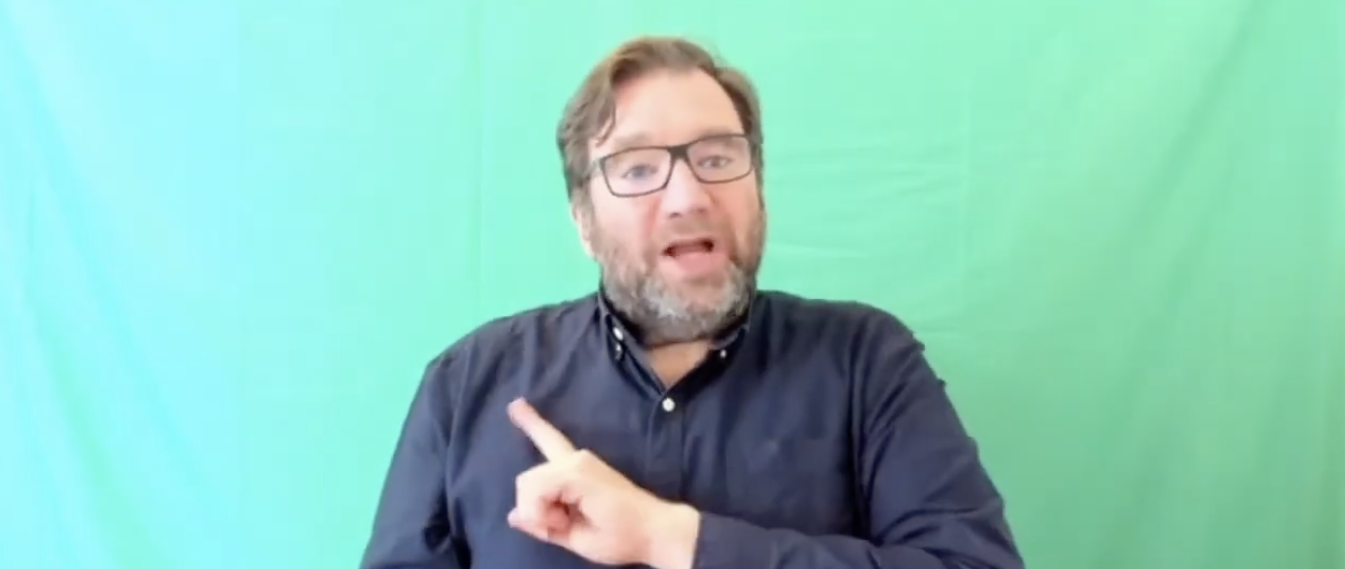
Robert Adam explains how deaf people often write or translate for each other, a practice called “ghostwriting.” He shows how this supports the community and connects to the role of Deaf interpreters. Below you can watch the summary in BSL or continue scrolling down to read in English.
Hello, my name is Robert Adam. I am an Assistant Professor at Heriot-Watt University in Edinburgh. Previously, I worked at DCAL, the Deafness, Cognition and Language Research Centre at University College London, for twelve years. I began there as a research assistant and later became the Director of Continuing Professional Development courses. In that role, I also had teaching and other academic responsibilities.
My research interests include multilingualism, bilingualism, minority sign language communities, and deaf interpreters.
I became interested in researching ghostwriting, as discussed in my paper, because I grew up as a child language broker. As a child, I often mediated language for my parents and others in the deaf community. My parents came from different sign language backgrounds. My father used Auslan, or Australian Sign Language. My mother used Australian Irish Sign Language. I observed both of these language varieties in my home environment.
An example of language brokering from my childhood would be when I needed a sick note for school. I would write the note myself, give it to my mother to copy and sign, and then hand it in to school. In this way, I was writing what I saw my parents saying. This experience of writing on behalf of others shaped my understanding of translation and interpreting. It made me wonder whether others had similar experiences.
I also know that hearing people often become sign language interpreters by being friends with deaf people, working with deaf people, or enrolling in training programs to learn sign language and become qualified. However, we have not had the same conversations within the deaf community about how deaf people become interpreters or translators. I am interested in learning more about this process. I want to know how it begins, what experiences deaf interpreters gain, and what pathways exist for them. While we know quite a bit about hearing interpreters, we know much less about deaf interpreters who emerge from within the community. I want to explore that history.
To investigate this, we are conducting research into people’s experiences and practices. Three of us are working together on this study. I am working with Christopher Stone, who is hearing, and Bríde Cartwright, who is deaf. Together, we are interviewing deaf people to learn about their experiences as ghostwriters.
We chose the term “ghostwriting” because, when I was younger, I heard it used at the deaf club. I would notice that some Deaf individuals had strong written English skills, while others did not. If someone received help with a written message, people might say, “That has been ghostwritten,” and the term stayed with me. That is why we chose to use it in our study.
We want to learn about how people started ghostwriting, what they do in that role, and how this activity functions in their everyday lives. We are interviewing deaf people in both Australia and the United Kingdom. When designing the study, we ensured gender balance by interviewing an equal number of men and women. At the time of the study, all of our participants were white. In future research, we are interested in exploring how ghostwriting and language brokering occur within Deaf minority ethnic communities. We want to see how these communities support one another as translators, interpreters, and brokers.
From our interviews, we have found that deaf people typically begin ghostwriting in two main settings.
The first setting is deaf schools. In school environments, teachers often struggled to understand some students. Another pupil would step in to interpret or rephrase what the deaf student meant. Similarly, when students did not understand the teacher, another student might clarify the message. Ghostwriting also happened with writing. One pupil might write a letter for another student to copy and send. This practice became a form of mutual support, especially in dealing with written English and translation tasks.
The second common setting is the deaf club. In these community spaces, individuals would share their different strengths. One person might be skilled at carpentry. Another might be talented at mechanics or sewing. Some people were especially skilled at written English, and they would help others who struggled with it. Growing up, I knew exactly who in the deaf community had strong written English skills. I saw deaf people regularly go to them for help. When someone did not understand a letter or needed to write a response, they would sign their reply and have someone else write it down. In other cases, if someone had an important appointment, they might ask another deaf person to accompany them and help with communication. Often this happened through gesture or other creative strategies. These were resourceful, community-based methods that deaf people used to support one another in dealing with spoken and written English.
This research helps us understand how deaf interpreters, translators, and language brokers develop their skills. We know that for hearing interpreters, there are professional associations, qualification pathways, and registration systems. For deaf interpreters, much of this remains undocumented. There is no formal history, even though deaf interpreting clearly exists. We want to explore how it develops within the community, what value is placed on it, and how the learning process compares with that of hearing interpreters.
We see this as a hidden history that has not been widely recorded or discussed.
There is also historical evidence showing that deaf interpreters played roles in society as far back as the sixteenth and seventeenth centuries. For example, under the Napoleonic Code, Deaf people appearing in court were required to have a deaf interpreter. These events are part of historical record, but they are not widely known. Many people do not realize that deaf interpreters have played important roles throughout history. We believe this history should be made more visible. It has valuable implications for interpreter training, professional development, and the sharing of knowledge and skills in the field of interpreting.
If you’re interested in other lay summaries, have a look here:
https://www.ucl.ac.uk/brain-sciences/dcal/resources-dcal/dcal-lay-summaries
Reference:
Adam, R., Carty, B., & Stone, C. (2011). Ghostwriting: Deaf translators within the Deaf community. Babel. Revue Internationale de La Traduction / International Journal of Translation, 57(4), 375–393. https://doi.org/10.1075/babel.57.4.01ada
Enjoying our eggs? Support The Limping Chicken:

The Limping Chicken is the world's most popular Deaf blog, and is edited by Deaf writer and photographer Charlie Swinbourne.
Our posts represent the opinions of blog authors, they do not represent the site's views or those of the site's editor. Posting a blog does not imply agreement with a blog's content. Read our disclaimer here and read our privacy policy here.
Find out how to write for us by clicking here, and how to follow us by clicking here.
This site exists thanks to our supporters. Check them out below:
- Lumo TV: TV programmes in BSL for the Deaf community
- Bellman & Symfon: home alerting solutions, including the mobile phone transceiver!
- SignVideo: Instant BSL video interpreting online
- British Deaf Association: Working to transform the way BSL is accessed in the UK
- 999 BSL: call 999 in an emergency, in BSL
- Deaf Umbrella: Making colleges and workplaces more accessible
- Appa: Looking for RSLIs, TSLIs and CSWs, apply here!
- Signly: Adding BSL to websites
- Signworld: Learn BSL online!
- DCAL: world-class research into deafness, cognition and language
- Lipspeaker UK: specialist lipspeaking support
- BID: Deaf services, including advice and support, interpreting, employment and letters
- Interpreting Matters: BSL interpreting agency
- Sign Solutions: Instant access to Interpreters, training and BSL translation nationwide
- InterpretersLive: On demand BSL video interpretation
- Performance Interpreting: BSL interpreting at concerts
- National Deaf Children's Society: The leading charity for deaf children
- Action Deafness: “A Deaf-Led Charity” – interpreting & community support services





Joana Morêdo Pereira
October 16, 2025
Thank you, dear Robert Adam, and all at Limping Chicken, for this amazing article. I will use it in the undergraduate program for sign language interpreters where I teach, here in Portugal.
Joana Pereira
Martin Glover
October 17, 2025
Cool, Robert! Interesting article! I don’t consider myself deaf interpreter / translator formally but done plenty of ‘ghostwriting’ as you described when I was 20’s /30’s in my home towns (However, I experienced on both side of it (my input into the community and getting support for my university stuff) and wonder whether you looked this kind of the particular trend. Fantastic stuff!