
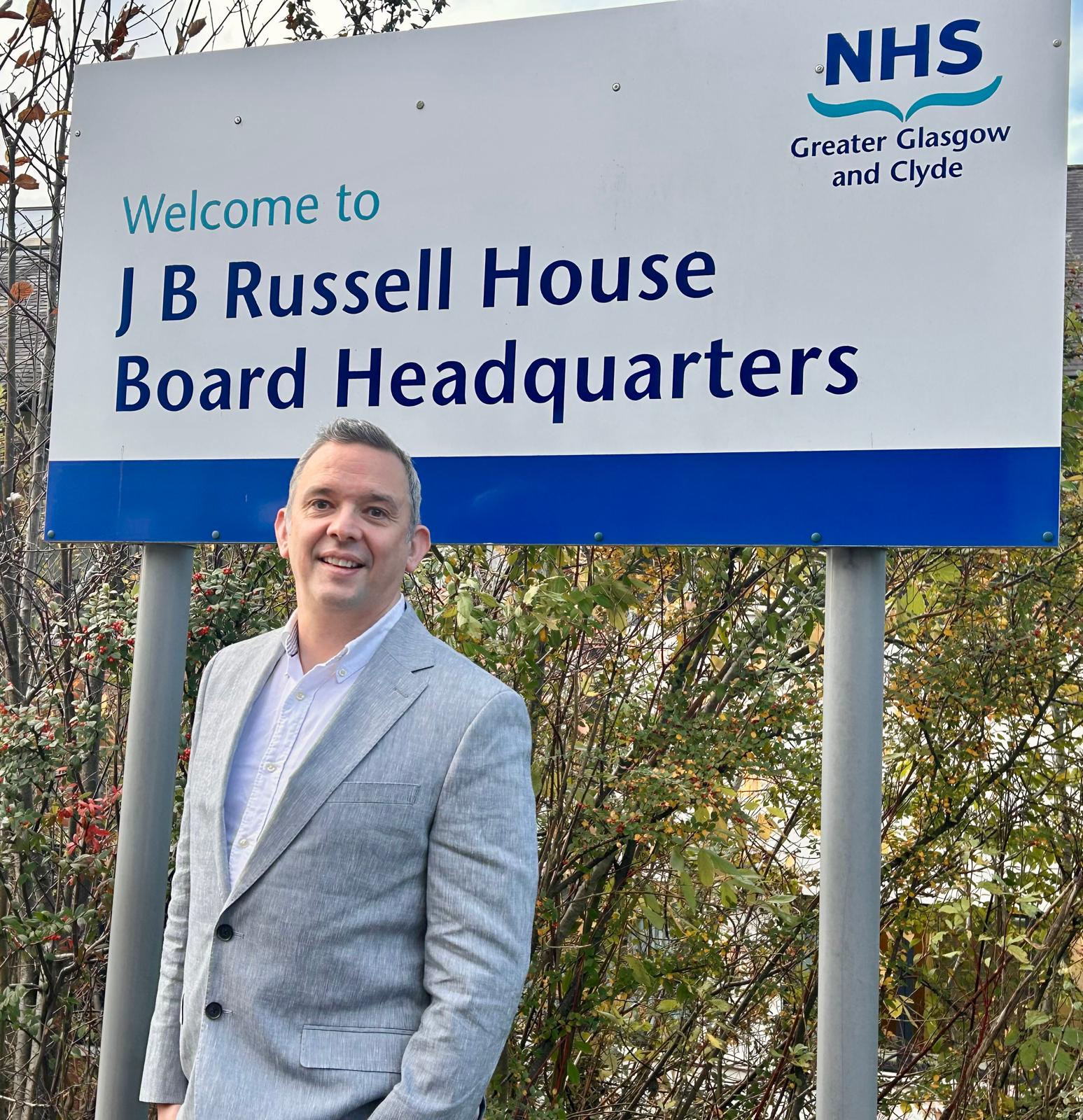
For the past nine years, I’ve worked as a Health Improvement Specialist for the Deaf Community under the Equality and Human Rights Department at NHS Greater Glasgow & Clyde. My job is to improve access for deaf patients, reduce health inequalities, and make sure British Sign Language (BSL) users can fully take part in their healthcare.
Over this time, I’ve worked on many projects — from creating new ways to book interpreters, to running staff training, to making sure deaf people are visible in the NHS. But my work is just one part of a bigger journey.
Every NHS Board in Scotland and every NHS Trust in England has an Equality and Diversity (or Equality and Human Rights) Officer/Manager. Their role is to make sure services are fair, accessible, and follow the law. They usually report through equality or patient experience committees up to the Chief Executive and Board.
The set-up isn’t the same everywhere in the UK, but these officers often work closely with NHS departments such as Interpreting Services, Public Health, Medical Records, and Chief Nurses. Together they look at things like interpreter booking systems, accessible information, and making sure patients’ needs are recorded.
 It makes a huge difference when deaf people are employed within these teams. While not common everywhere, having deaf staff involved brings lived experience and helps services understand BSL as a language in its own right and as part of Deaf culture — enriching the communication experience, especially in healthcare. This reflects the social model of communication, where barriers lie with the system, not the person. When NHS staff approach deafness through the medical model, seeing it as something to be fixed, trust is already lost. The social model reminds us that equality starts when services adapt to meet the person — not the other way around.
For many deaf people, dealing with the NHS can feel daunting and demoralising. But there are steps that can help. One of the best things you can do is ask about access before your appointment. Contact your local Equality Officer and ask: “What support do you provide for BSL users?” You can usually find them on your NHS Board or Trust website, by asking PALS in England, the Patient Experience Team in Scotland, or through your local Deaf organisation.
Don’t be afraid to ask further questions. You might want to know which interpreting agency they use, whether the interpreters are fully qualified, if NHS staff know how to book them, and what happens if things go wrong. Asking these questions doesn’t make you difficult — it ensures services do their job properly.
It also helps to keep a note if access fails, such as when an interpreter isn’t booked or you don’t receive information in BSL. Having that record makes it easier to raise the issue later.
If your local NHS has support services that are accessible to BSL users, try to use them. If you’re not sure what’s available, ask your local Deaf organisation — they can point you towards tools like VRS for contacting services or offer advice on how to raise issues. These are your rights, and you don’t have to manage it alone.
Local Deaf organisations also have a big role to play by building strong working relationships with their local NHS. Getting involved in patient participation groups is one way to make sure the Deaf community’s voice is heard when decisions are made. Organisations can also help by checking that interpreters are booked and used properly, and by feeding back when things go well as well as when they don’t.
Sharing examples of good practice from other NHS Boards and Trusts is powerful — it shows that improvements are possible and encourages services to follow suit. Embracing technology, such as VRS (by phoning appointment or making a complaint) or online interpreting at medical site, is another area where Deaf organisations can guide the NHS on what works well and what still needs improving.
By working in partnership, Deaf organisations and the NHS can move from one-off fixes to lasting change that makes healthcare fairer and more accessible for everyone.
- Improving access for Deaf people isn’t just “a nice thing to do” — it’s a legal duty. The Equality Act 2010 requires the NHS to:
- Stop discrimination, including indirect discrimination such as failing to provide an interpreter.
- Give Deaf people fair and equal access to services.
- Promote better understanding, for example through Deaf awareness.
This means the NHS shouldn’t wait until someone complains. Services should plan ahead, train staff, and make sure systems are in place to give BSL users the support they need.
In Scotland, the BSL (Scotland) Act 2015 requires public bodies, including NHS Boards, to promote BSL and improve access. At NHS Greater Glasgow & Clyde, we’ve tried to move from reacting to planning. Here are some of the things we’ve put in place:
- BSL Mediator – a Deaf staff member who helps BSL patients with complaints, letters, bookings and navigating NHS systems.
- Online interpreting in A&E – on-demand SignVideo interpreting, useful for emergencies and ward chats when face-to-face interpreters can’t be booked at the last minute. We’re still developing clear guidelines for staff, because technology is useful but not always reliable — online interpreting isn’t a quick fix or a replacement for face-to-face interpreting.
- BSL classes for staff – every summer and autumn, with over 600 staff taking part since 2019, taught by Deaf tutors.
- Deaf staff in the workforce – Deaf people working as translators, volunteers, trainers, mediators, and even a Deaf Clinical Psychologist and a Deaf Consultant Neurologist.
- Accessible information – QR codes on letters linking to BSL videos, systems for booking interpreters, and patient record alerts that flag communication needs.
- Direct BSL complaints – we’ve developed a website that allows BSL users to contact the NHS Greater Glasgow & Clyde Complaints Team directly via the VRS (video relay service), using a BSL interpreter. This makes it easier for BSL users to communicate their concerns and grievances in their own language, giving them both power and the right of reply.
- Mental health access – our NHS Greater Glasgow & Clyde Deafness and Mental Health Group works with colleagues to make services fairer for BSL users.
- These examples are from NHS Greater Glasgow & Clyde, but similar steps can be taken anywhere in the NHS.
We also need to be realistic. Access to BSL in the NHS is improving, but there are still challenges — not enough interpreters, differences between regions, and the difficulty of finding someone at the last minute for emergencies. We also need to look more closely at how the system actually works for Deaf people in practice. There should be a much closer examination of how Deaf patients’ recorded communication needs are being met, and how NHS staff book interpreters in real situations. At the moment, there are still significant gaps in this process that need to be addressed to make the experience smoother and more reliable for Deaf people.
That doesn’t mean Deaf people should accept poor access. It means we need honest conversations about what’s possible, how online interpreting can help in some cases, and how services balance duties with real-world pressures. The NHS should be open and consistent, and Deaf patients should feel confident to ask questions and expect clear answers.
For Deaf patients, access isn’t just about providing interpreters. It’s also about seeing BSL in the NHS and knowing your language is respected. Visibility builds trust. And trust is essential for good healthcare.
Paul has been profoundly deaf since birth and works as a Health Improvement Specialist in the Equality & Human Rights team at NHS Greater Glasgow & Clyde. He’s passionate about breaking down barriers to healthcare — and just as passionate about breaking out his dance moves at Glasgow’s music venues. When he’s not improving access to NHS services, you’ll probably find him at an accessible pub quiz or somewhere near a festival stage (he’s been to Glastonbury an impressive 18 times!). Paul believes access shouldn’t stop at hospital doors — it belongs on the dance floor too
Enjoying our eggs? Support The Limping Chicken:

The Limping Chicken is the world's most popular Deaf blog, and is edited by Deaf writer and photographer Charlie Swinbourne.
Our posts represent the opinions of blog authors, they do not represent the site's views or those of the site's editor. Posting a blog does not imply agreement with a blog's content. Read our disclaimer here and read our privacy policy here.
Find out how to write for us by clicking here, and how to follow us by clicking here.
This site exists thanks to our supporters. Check them out below:
- Lumo TV: TV programmes in BSL for the Deaf community
- Bellman & Symfon: home alerting solutions, including the mobile phone transceiver!
- SignVideo: Instant BSL video interpreting online
- British Deaf Association: Working to transform the way BSL is accessed in the UK
- 999 BSL: call 999 in an emergency, in BSL
- Deaf Umbrella: Making colleges and workplaces more accessible
- Appa: Looking for RSLIs, TSLIs and CSWs, apply here!
- Signly: Adding BSL to websites
- Signworld: Learn BSL online!
- DCAL: world-class research into deafness, cognition and language
- Lipspeaker UK: specialist lipspeaking support
- BID: Deaf services, including advice and support, interpreting, employment and letters
- Interpreting Matters: BSL interpreting agency
- Sign Solutions: Instant access to Interpreters, training and BSL translation nationwide
- InterpretersLive: On demand BSL video interpretation
- Performance Interpreting: BSL interpreting at concerts
- National Deaf Children's Society: The leading charity for deaf children
- Action Deafness: “A Deaf-Led Charity” – interpreting & community support services





hmccoll84f5488ef1
November 3, 2025
It’s good to know that BSL users have an NHS champion who can get things done. Please can you tell those of us who are deaf English users who fulfills `similar role for us?
Tim Blackwell
November 7, 2025
This is great to see. A successful Deaf person using their skills and vocation to help make sure that this crucial arm of the welfare state – the National Health Service – can be accessed by D/deaf people. Well done!
It is in stark contrast to the scandal some years back, when false “leaders” were signing NDAs (non disclosure agreements) preventing themselves from speaking out when D/deaf people had their social security human rights (another crucial arm of the welfare state) violated, as per ongoing UN findings of ‘grave and systematic’ abuse.
Let’s hope that new leaders will follow Paul’s example.