
Limping Chicken are sharing a range of lay summaries for research by DCAL (Deafness Cognition and Language Centre), here is the 2nd post, from 2011:
Click here to watch this on YouTube
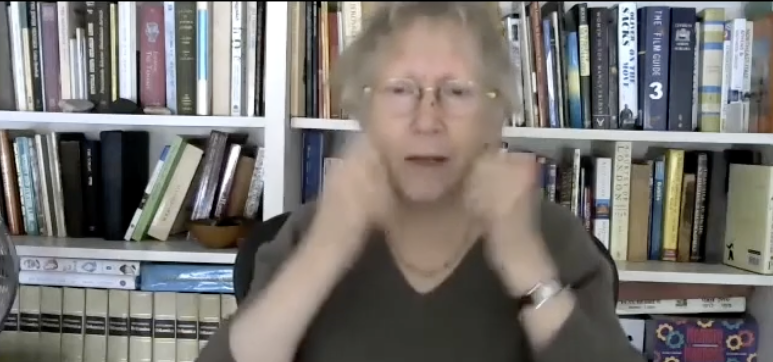
Bencie Woll takes part in an interview with Clive Mason. She explains how the brain processes BSL and gives examples to show this.
Clive Mason (Interviewer):
I would like to start by asking you to introduce yourself. Could you please tell us your name and talk a bit about your work in linguistic research?
Bencie Woll:
Hello, my name is Bencie Woll. I am a researcher in sign linguistics, and I have been working in the field of British Sign Language linguistics for many years. I prefer not to say exactly how many.
How Does Sign Language Work in the Brain?
Much of what we know about how the brain processes language comes from studying people who have language difficulties. These difficulties may occur in spoken language for hearing individuals or in sign language for deaf individuals.
For example, people who experience a stroke affecting the left side of the brain often develop aphasia. This condition can make it difficult to produce or understand both spoken and signed language.
When the right side of the brain is affected, a person’s language use may seem unaffected at first. However, they may struggle with facial expressions. Their face might appear expressionless, and they may have trouble understanding questions or negation, both of which are frequently conveyed through facial movements in British Sign Language.
To summarise this:
The left hemisphere of the brain is responsible for processing signs and grammar.
The right hemisphere is responsible for processing facial expressions and prosody, which includes the rhythm and intonation of language.
This understanding has important clinical implications. It can guide the development of sign language therapy that functions similarly to speech therapy. Unfortunately, sign language therapy is not yet widely available.
Sign Language Therapy
By understanding how the left and right hemispheres support different aspects of British Sign Language, we can design more targeted therapeutic approaches.
Training in facial expression may help support the functions typically handled by the right hemisphere. Manual sign training may help support those processed in the left hemisphere.
Professionals could be trained specifically to become sign language therapists using this brain-based framework. For instance, if someone has had a stroke on the right side of the brain, they might benefit from strategies such as adding manual question signs to aid comprehension, practicing recognition and production of facial expressions, and avoiding the use of facial expressions alone to indicate negation.
Research Findings
We have worked on several cases that illustrate how the brain processes sign language. Here are three examples.
Hearing Identical Twins with Down Syndrome
These twins were raised by deaf parents and used British Sign Language from an early age. They experienced delays in both English and British Sign Language. Neither language was stronger than the other, but their gestural communication was excellent. This suggests that their difficulties were specifically related to language, rather than the communication modality.
Hearing Boy with Epilepsy
This boy was born hearing and initially had no language issues. However, around the age of four, he developed epilepsy and lost his ability to understand spoken language, despite retaining normal hearing. At age thirteen, he entered a school for deaf children and began learning British Sign Language. This experience transformed his life. His brain damage had not affected the areas responsible for sign language processing, so learning British Sign Language gave him a new way to communicate. He now uses both music and sign language and moves fluidly between both worlds.
Deaf Woman with Williams Syndrome
Children with Williams Syndrome are often very verbal in spoken language but tend to have difficulties with visual and spatial tasks. This deaf woman enjoyed signing and taught others to fingerspell. However, she avoided using spatial grammar in British Sign Language. For example, she would not use spatial mapping to sign “the pen is on the table.” Instead, she would sign the sentence in a linear sequence. Although her language abilities were intact, her limited spatial cognition prevented her from using classifiers and spatial structures effectively.
Developmental Language Disorder in Deaf Children
Among hearing children, approximately seven percent have Developmental Language Disorder. This is a difficulty in acquiring language that is not related to a broader cognitive impairment. We wanted to investigate whether a similar pattern exists among deaf children.
We studied a deaf boy who had deaf parents and consistent exposure to British Sign Language from birth. By the age of five, he was still not forming complete British Sign Language sentences. His sister had developed normally. He often repeated questions rather than responding to them. He was later diagnosed with a language-specific learning issue.
Our findings suggest that about five to six percent of deaf children experience similar difficulties. Unfortunately, these issues are often overlooked or misunderstood. People may assume the difficulties are due to deafness itself, rather than recognising them as language-learning problems.
There is a clear need for trained sign language therapists to support these children, just as speech therapists support hearing children with developmental language disorders.
Training and Applications
Clive Mason:
Do your research findings influence how teachers and therapists are trained?
Bencie Woll:
Yes, absolutely. We are now working directly with deaf teachers and classroom assistants. We are providing training that helps them support the communication needs of children more effectively.
Broader Benefits of the Research
My research offers a number of benefits. It helps deaf children and their families by identifying and addressing language difficulties at an early stage. It also supports researchers and clinicians by expanding our understanding of how the brain processes language, including signed languages. Most importantly, it brings together theoretical knowledge and practical application.
What Is the Name of This Field?
Clive Mason:
What is the name of this field? Is it called neurology or cognition?
Bencie Woll:
The formal name is the neurobiology of language. At the moment, there is no single agreed-upon sign for this term. Instead, we tend to use signs that represent related concepts, such as “cognitive” or “science of language.” Perhaps in the future, a shorter and more standardised sign will be created.
Closing Remarks
Clive Mason:
Thank you so much for your time and insights. It is clear that this research is developing quickly and already having a positive impact on users of British Sign Language, as well as on educators and clinicians.
Bencie Woll:
Thank you. It has been a pleasure to share this work.
If you’re interested in other lay summaries, have a look here:
https://www.ucl.ac.uk/brain-sciences/dcal/resources-dcal/dcal-lay-summaries
Reference:
Woll, B., & Morgan, G. (2011). Language impairments in the development of sign: Do they reside in a specific modality or are they modality-independent deficits? Bilingualism: Language and Cognition, 15(1), 75–87. https://doi.org/10.1017/s1366728911000459
Enjoying our eggs? Support The Limping Chicken:

The Limping Chicken is the world's most popular Deaf blog, and is edited by Deaf writer and photographer Charlie Swinbourne.
Our posts represent the opinions of blog authors, they do not represent the site's views or those of the site's editor. Posting a blog does not imply agreement with a blog's content. Read our disclaimer here and read our privacy policy here.
Find out how to write for us by clicking here, and how to follow us by clicking here.
This site exists thanks to our supporters. Check them out below:
- Lumo TV: TV programmes in BSL for the Deaf community
- Bellman & Symfon: home alerting solutions, including the mobile phone transceiver!
- SignVideo: Instant BSL video interpreting online
- British Deaf Association: Working to transform the way BSL is accessed in the UK
- 999 BSL: call 999 in an emergency, in BSL
- Deaf Umbrella: Making colleges and workplaces more accessible
- Appa: Looking for RSLIs, TSLIs and CSWs, apply here!
- Signly: Adding BSL to websites
- Signworld: Learn BSL online!
- DCAL: world-class research into deafness, cognition and language
- Lipspeaker UK: specialist lipspeaking support
- BID: Deaf services, including advice and support, interpreting, employment and letters
- Interpreting Matters: BSL interpreting agency
- Sign Solutions: Instant access to Interpreters, training and BSL translation nationwide
- InterpretersLive: On demand BSL video interpretation
- Performance Interpreting: BSL interpreting at concerts
- National Deaf Children's Society: The leading charity for deaf children
- Action Deafness: “A Deaf-Led Charity” – interpreting & community support services





Posted on January 23, 2026 by Editor