
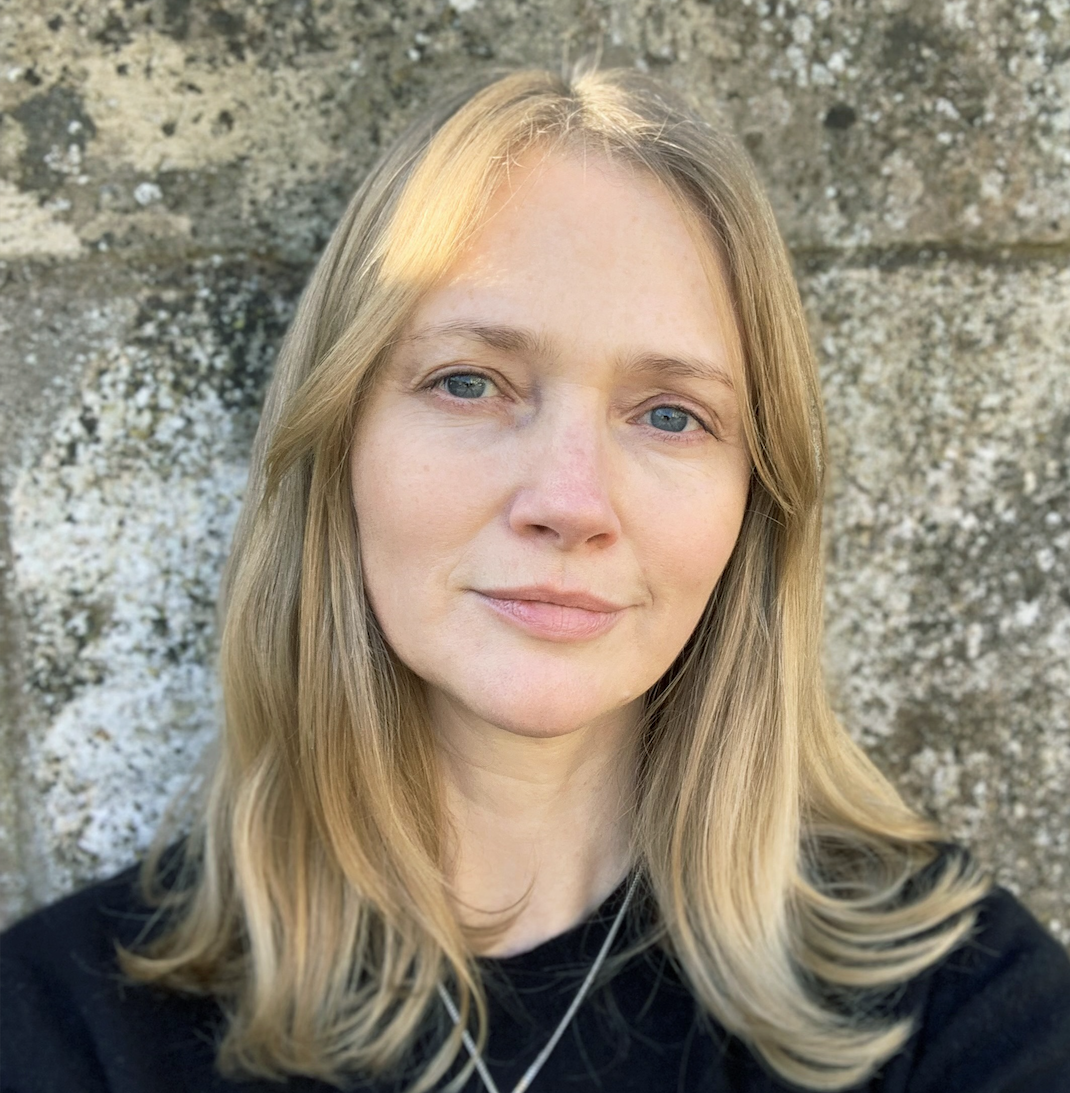
Hello! I’m Jan, and I’m an author of teen and young adult fiction. I live in Bath, with my husband and two children. When I’m not writing, I work as a teacher – I’m a qualified primary art specialist, so I get to spend lots of time supporting young people to be creative.
My route into writing was pretty winding; I’ve done many strange jobs, but the most unusual was working as a fashion model. That experience inspired my debut novel, Mirror Me, which won the Oxfordshire Children’s Book Award, 2024.
Hearing loss runs in my family. My Dad, Mike, is profoundly deaf and so was his Mother, Lillian, my Grandmother, so I grew up being a little more deaf-aware than most young people my age. Both my Dad and Grandmother lost their hearing in young adulthood, and while neither of them learned BSL, they wore bilateral hearing aids and were pretty good lip-readers.
With my Grandmother especially, my sister and I learned from an early age that we needed to be thoughtful in the way we communicated so she could understand us and be included in conversations.
With my Dad, advances in hearing aid technology definitely benefitted him, but about twelve years ago, he had cochlear implant surgery. While this isn’t a choice for everyone, it’s been a fascinating journey and transformative for my Dad in many ways.
A common feature of my childhood was the regular whistling of my Grandmother or my Dad’s hearing aids – my sister and were completely used to it, but it would take our friends by surprise! So those sorts of things were quite funny, but if I’m honest, some memories leave me with mixed feelings.
My Grandmother used to apologise a lot before she said things in case she’d misunderstood or missed the point, and I feel sad that she felt that was necessary. I especially hated when people talked about her as though she wasn’t there.
It also frustrated me if people mumbled when talking to my Dad, or spoke without looking at him – sometimes they’d even get impatient, assuming he hadn’t understood them, when really he simply hadn’t heard.
My Dad is fiercely independent and he’s never been one to ask for help! He was a teacher before he retired, and I’m not sure his students ever knew the full extent of his deafness.
What his students didn’t know was that he couldn’t actually hear the bell ring, so he had to go on body language to work out when the lesson had ended! I think he definitely played into this slightly aloof persona, because it helped him to control the class!
As a writer, I write contemporary retellings of fairytales, refreshed and updated for a modern audience! My new novel The Last Thing You’ll Hear is loosely based on The Pied Piper, and it tells the story of Wren and Lark, two musical sisters who become bitter rivals when an enigmatic music producer called Adam arrives in their small town of Hamlington, and offers them the chance to perform at mysterious musical festival Enrapture.
But there’s more to Enrapture than meets the eye, and Adam has plans to exploit the sisters’ talents for his own gain. The story explores themes of influence, obsession, toxic masculinity and dangerous fandoms, and it’s a page-turning summer thriller for young adults and teens!

One of the characters – Danny – has hearing loss. Danny is a really important character in the book, but he isn’t the protagonist as the person telling the story is his best friend, Wren.
I didn’t feel it was right for me as a hearing person to write from the point of view of a deaf person. But Danny is a key character and integral to the plot – as well as being the love interest!
Danny is a seventeen-year-old boy and a talented guitarist. He also has severe hearing loss, caused by a viral infection a few years prior to when the story begins. Since then, he’s continued to play his guitar privately, but has lost confidence to perform in public. Danny is well supported by his family and friends but unfortunately, he does meet people who make ignorant assumptions about him.
Danny has a main role in the story, helping Wren to overcome Adam’s dangerous plans – but he also has an important subplot of his own, which sees him struggling to decide with his parents about whether to have CI surgery. Danny is unsure, because he’s worried about how the surgery could change his experience of music. I did consult with audiologists on this.
Without wanting to spoil the story, I’ll just say that by the end, Danny hasn’t reached a decision yet although he strongly resists the idea that he needs to be ‘fixed.’ I deliberately left his dilemma unresolved because the CI journey is not for everyone.
Instead, we see Danny growing in confidence as a musician and expanding his definition of what music is – that it’s more than just sound. The feelings, relationships, sense of community and belonging is just as important, if not more so.
So many different things inspired Danny’s character. When I decided to write a book about music, I knew early on that I wanted to include a musician who has hearing loss. In part this was because The Last Thing You’ll Hear draws on the fairytale of The Pied Piper, and in many versions of this tale, a deaf child plays an important part in alerting the village to the piper’s threat.
I wanted to create a hero character in order to be faithful to that tale. But a bigger reason was because both my Dad and Grandmother were musicians and music-lovers themselves.
My Dad helped me a lot with Danny’s storyline, talking to me about what it’s like to experience music as a deaf person, and how he plays guitar and piano with hearing aids – as well as how his experience changed after his CI surgery.
But my Dad’s experience is only one point of view, so I spoke to other deaf musicians and also spent time in the deaf provision unit of a school in London where music is an important part of the curriculum. I observed the students having their regular music lessons with a group called Creative Futures and it was brilliant hearing from those students about the joy that music brings them and their personal ambitions as musicians.
I was also inspired by deaf visual artist Christine Sun Kim who explores musical notation, voice, sound and ASL in her work.
Finally, I learned about the sign language interpreters who make live music accessible to deaf concert-goers.
All these things convinced me that it was important to write inclusively about music. As for how readers see Danny and whether they relate to him – well, I just hope he feels like a real, fully-rounded teenager!
I’m now working on a number of new projects and I’m at various stages of researching, plotting, drafting and editing each one.
I get asked a lot – what advice would you give to budding writers? – especially on school visits, and I think my advice is still the same.
If you want to write, read. Reading is SO important. It teaches you the craft of storytelling. If you know what type of fiction you’d like to write, make it your job to read anything and everything in that genre; familiarise yourself with the techniques those authors use.
If novels aren’t your thing, watch TV or go to the cinema – the main thing is to immerse yourself in stories. The other thing you can do is try to make writing a habit. Sit down and write regularly, a little bit at a time, as often as you can. The words will soon mount up.
You can find Jan’s latest book ‘The Last Thing You’ll Hear’ available to purchase here.
Enjoying our eggs? Support The Limping Chicken:

The Limping Chicken is the world's most popular Deaf blog, and is edited by Deaf writer and photographer Charlie Swinbourne.
Our posts represent the opinions of blog authors, they do not represent the site's views or those of the site's editor. Posting a blog does not imply agreement with a blog's content. Read our disclaimer here and read our privacy policy here.
Find out how to write for us by clicking here, and how to follow us by clicking here.
This site exists thanks to our supporters. Check them out below:
- Lumo TV: TV programmes in BSL for the Deaf community
- Bellman & Symfon: home alerting solutions, including the mobile phone transceiver!
- SignVideo: Instant BSL video interpreting online
- British Deaf Association: Working to transform the way BSL is accessed in the UK
- 999 BSL: call 999 in an emergency, in BSL
- Deaf Umbrella: Making colleges and workplaces more accessible
- Appa: Looking for RSLIs, TSLIs and CSWs, apply here!
- Signly: Adding BSL to websites
- Signworld: Learn BSL online!
- DCAL: world-class research into deafness, cognition and language
- Lipspeaker UK: specialist lipspeaking support
- BID: Deaf services, including advice and support, interpreting, employment and letters
- Interpreting Matters: BSL interpreting agency
- Sign Solutions: Instant access to Interpreters, training and BSL translation nationwide
- InterpretersLive: On demand BSL video interpretation
- Performance Interpreting: BSL interpreting at concerts
- National Deaf Children's Society: The leading charity for deaf children
- Action Deafness: “A Deaf-Led Charity” – interpreting & community support services





Posted on June 25, 2025 by Rebecca A Withey