
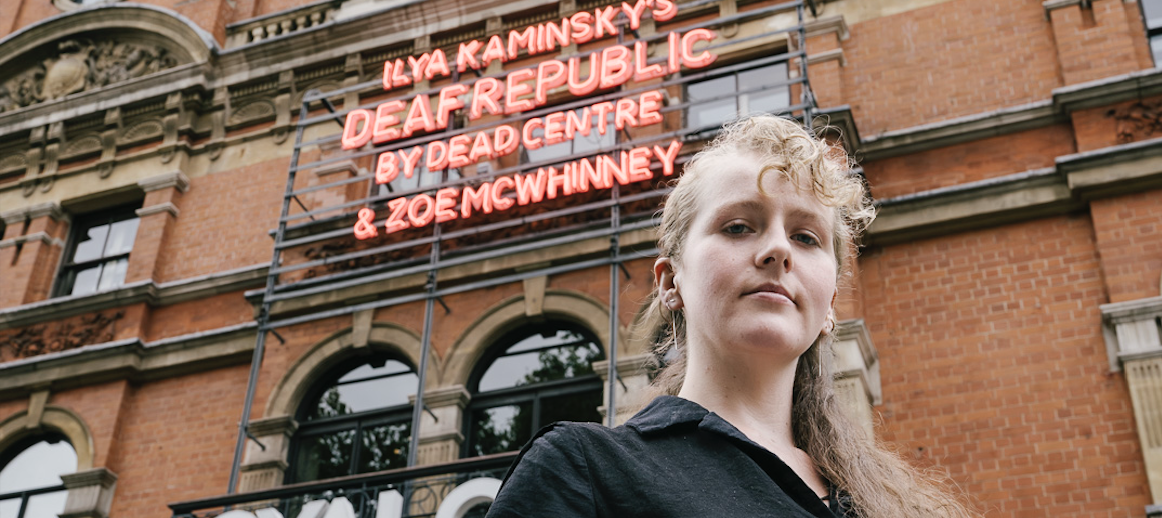
Zoë McWhinney has had a varied career as a Sign Language Poet, an actor, director, BSL consultant, and is now making her writing debut as a co-playwright for the highly anticipated Royal Court production of Deaf Republic, adapted from a collection of poems by Ilya Kaminsky.
The production will play at the Royal Court Theatre, London before being shown at the Dublin Theatre Festival in Ireland. It is produced by Dead Centre theatre company, with the company’s founders Bush Moukarzel and Ben Kidd as co-writers. Deaf actors Romel Belcher and Lisa Kelly are among the actors starring in the show. Charlie Swinbourne interviewed Zoë after a rehearsal (which he also photographed) earlier this week.
Tell us briefly what Deaf Republic is about?
There is a military occupation of the fictional town called Vasenka. A deaf boy is shot because he didn’t hear a soldier’s orders. The town goes deaf overnight in revolt. It’s a boycott, a really committed one. And of course, as a Dead Centre production, it’s subversive and meta.
This looks like a remarkable production from what I’ve just seen. Is this the biggest thing you’ve been involved in so far?
Maybe the biggest thing before this was acting at Shakespeare’s Globe last year, but yes I think this is the biggest thing so far – definitely as a writer! And personally I’m so stoked to show my work at Royal Court of all theatres, especially because of its ethos as a playhouse for the under-represented under the current artistic directorship, unafraid to tackle the political zeitgeist.
To give some context, the strongest impression of what the Royal Court stands for was when I watched the show “For Black Boys Who Considered Suicide When the Hue got Too Heavy” at Royal Court with my cousin, when BLM was at its height. I remember sitting at the back row of the circle and thinking “wow even from here I can see how ideal it would be if Royal Court hosted a Deaf-centred show here, the size and shape of this place is so beautifully BSL-friendly”. And now look at us, sitting in the Royal Court having this interview! It’s the biggest blessing.

Lisa Kelly and Eion Gleeson in rehearsals for Deaf Republic (photo by Charlie Swinbourne)
How did you get involved?
They were looking for a Deaf person with expertise in International Sign with a network of deaf signers around the world, poetry and VV (Visual Vernacular). Zoo&Co, with whom I’ve had a fantastic creative working relationship with, recommended me to Dead Centre because they felt I could be entrusted with conveying the nuances of perspectives from within the deaf community. I was intrigued to work with Dead Centre as they’re known for adapting political poetry and literature. I also graduated with a Bachelors in International Relations, volunteered for international organisations so it felt like a great match for me.
Dead Centre wanted me involved from the start, and when I first met them in person, we couldn’t find an interpreter in time so we had to use speech-to-text software – not ideal! But afterwards though, I realised it was the perfect opportunity for me to see how they handled me, a proud and profoundly Deaf person who doesn’t speak – and they passed the vibe check! When they drew out their artistic vision of using puppetry and live projection on the whiteboard, and being really open to integrating my ideas on deafhood and sign language poetry, I was fully sold.

Romel Belcher in rehearsals (photo by Charlie Swinbourne)
How did the writing process go?
It was really smooth! The first scene had already gone through some research and development with Romel Belcher (who is the lead actor in the play) and Lydia Gratis, our deaf dramaturg, so that was already written. I felt the story in Ilya Kaminsky’s book had a lot of parallels with the modern world, with the theme of occupation. I felt this play would resonate with audiences. It is a rare thing – a story involving sign language and featuring Deaf lead characters that has a wider relevance and covers global themes.
What was your writing process?
I tend to operate by first articulating my thoughts and ideas in BSL as though I’m telling them to a Deaf friend, then writing it down in essays, sometimes with sentences of broken English, to polish until it’s standard English. And for this process, I wrote some reflective responses to Kaminsky’s story, characters and themes, especially those discussed in the writer’s room with Bush and Ben. As a team, Ben, Bush and I each wrote drafts or even just synopsises of scenes inspired by the poetry and plot already present in the book.
Some of Kaminsky’s poems are directly transposed into the script so we’d have characters speaking extracts of his poems to move the story forwards nicely. We’d discuss the poems, and sometimes their intricateness forced me to sign it word for word to identify words or phrases that weren’t allowing themselves to be translated into BSL.
I would glean meaning from these words using the context of the rest of the poems and experiment with different ways of interpreting what that expression would look like in a visual world.
Basically, working out who said what and why, using role shift and positionality to figure everything out. I wanted it to be really clear and at the same time poetic in BSL, so it was important to me to find the meaning and convey it.

Zoe watching rehearsals (photo by Charlie Swinbourne)
What was it like in the rehearsal room?
It was smooth – I’m used to being the BSL consultant in rehearsal rooms, the difference is that in the past because I was ‘just’ the consultant, I had no ownership of the scripts but this time, we could change things if I felt a scene wasn’t reading authentically, or if I had a whole new idea we could write that into the play.
It sounds like you’ve had a really positive experience!
Yes, I love working with Dead Centre! Ben and Bush were on the same wavelength and are willing to challenge what theatre means, to break the rules if they need to! They’re not precious, and if there were differences in opinions, they were generous and respectful of my perspective as a Deaf person, which was affirming. It’s refreshing. I believe it is the role of theatre and television to tell stories about the world as it is, like holding up a mirror to society, and that’s what this production does.

Lisa Kelly, Derbhle Crotty and Kate Finegan in rehearsals (photo by Charlie Swinbourne)
How similar is the play to the original book of poems?
It does have differences, but it follows the same basic structure and story. The play fleshes out the story around the poems, but there are also details the poems talked about that the play doesn’t highlight or include. Kinda like comparing a novel to a movie!
What do you think the deaf audience will feel when they see this play?
The goal is they’ll feel tickled, and engage with the subversion of the theatrical tradition within the play, but there are also some very intense scenes so it’ll be a hell of a rollercoaster! Military occupation is no walk in the park, and for this production, there will be hearing actors playing deaf. I ask that the audience allow the Deaf actors to play hearing too. That’s one layer of the subversion I’m talking about here.

Dylan Tonge Jones in rehearsals (photo by Charlie Swinbourne)
Tell us about Romel and Lisa’s performances?
It’s hard to put into words how proud I am of everything they’ve achieved in this show as actors. I’m so so stoked to be working as a poet and writer with them both, with Romel’s undeniable star quality and Lisa’s passion for bringing authenticity to this story and her character. As an actor myself, I see how the aerials, the explicit and violent scenes, performing opposite others who are signing BSL for the first time (to name a few such stunts) are very courageous things to take on as an actor… Maybe not the last one, since that’s a recurring thing deaf actors are used to facing, to be straight with you! Swap BSL out for any other language and any actor’s blood would run cold at the thought.
I’m kind of in awe of them, especially the castmates who are new signers too because they’ll also be performing the whole show in Irish sign language for the run in Dublin. A momentous task. So give them all the love!

Lisa Kelly getting ready for rehearsals (photo by Charlie Swinbourne)
What’s in the future for you? What are you hoping to do next?
This has been such a big year for me with quite a few big career moments. I want to keep telling stories reflecting the community I grew up in. I want to convey our Deaf heritage. In the future I’d love to help develop a streamlined way for deaf writers to write and edit in sign language the same as how we can in English, using our cameras and hands instead of keyboards.
I’d like to do more BSL poetry and I’m thrilled that my poem has been nominated for Best Single Poem – Performance Category by the Forward Poetry Prize, which I’ll be doing a recital for at Southbank this autumn.
Aside from my personal ambitions I’m trying my best to keep opening doors with things like workshops, for the British theatre arts and business worlds to move forward with deaf people, and create clearer pathways into careers, and better representation in casting panels, boardrooms and so forth. Implementing the BSL GCSE would be a huge positive step forward.
Find out more about Deaf Republic and how to see it at the Royal Court website: https://royalcourttheatre.com/whats-on/deaf-republic/
Photography and interview by Charlie Swinbourne.
Enjoying our eggs? Support The Limping Chicken:

The Limping Chicken is the world's most popular Deaf blog, and is edited by Deaf writer and photographer Charlie Swinbourne.
Our posts represent the opinions of blog authors, they do not represent the site's views or those of the site's editor. Posting a blog does not imply agreement with a blog's content. Read our disclaimer here and read our privacy policy here.
Find out how to write for us by clicking here, and how to follow us by clicking here.
This site exists thanks to our supporters. Check them out below:
- Lumo TV: TV programmes in BSL for the Deaf community
- Bellman & Symfon: home alerting solutions, including the mobile phone transceiver!
- SignVideo: Instant BSL video interpreting online
- British Deaf Association: Working to transform the way BSL is accessed in the UK
- 999 BSL: call 999 in an emergency, in BSL
- Deaf Umbrella: Making colleges and workplaces more accessible
- Appa: Looking for RSLIs, TSLIs and CSWs, apply here!
- Signly: Adding BSL to websites
- Signworld: Learn BSL online!
- DCAL: world-class research into deafness, cognition and language
- Lipspeaker UK: specialist lipspeaking support
- BID: Deaf services, including advice and support, interpreting, employment and letters
- Interpreting Matters: BSL interpreting agency
- Sign Solutions: Instant access to Interpreters, training and BSL translation nationwide
- InterpretersLive: On demand BSL video interpretation
- Performance Interpreting: BSL interpreting at concerts
- National Deaf Children's Society: The leading charity for deaf children
- Action Deafness: “A Deaf-Led Charity” – interpreting & community support services




Posted on September 2, 2025 by Editor