
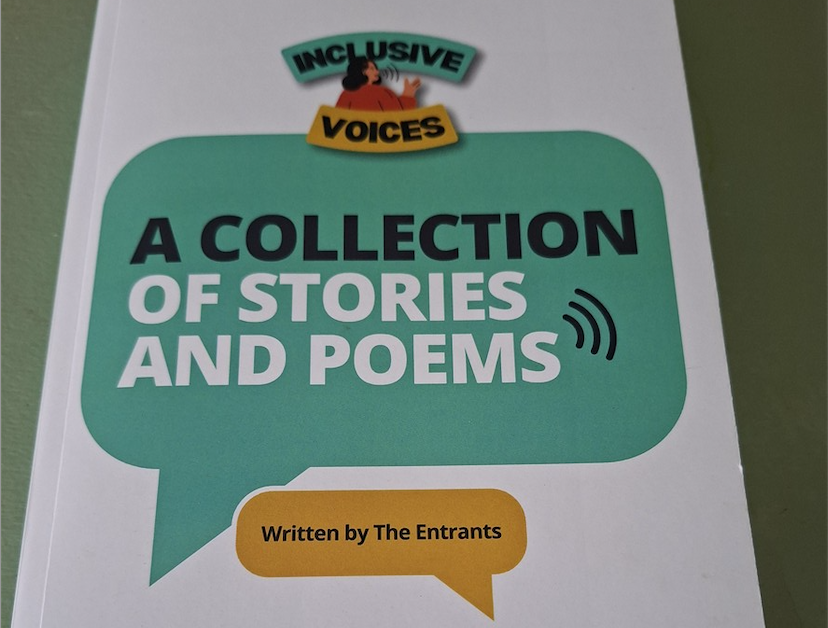
When Calibre Audio announced their new anthology Inclusive Voices, spotlighting stories and poems from people who have often felt excluded I felt compelled to respond.
The resulting short story Deaf Rapper sprang from years of witnessing my daughter grapple with an education system that often seems more committed to conformity than to imagination.
Though my daughter attended specialist deaf schools I found myself frustrated at attempts to advocate on her behalf because the ‘system’ always took precedent.
For example, when I asked for less Periodic Table and more practical skills, the reponse was colder than a penguin’s beak.
As a journalist, I’ve written countless pieces with tight deadlines but when clicks became more important than stories I decided to veer off on another path to pursue a creative writing degree. It opened my eyes to how fiction can shine a light on truths with a nuance that eludes some reportage.
Deaf Rapper emerged from that shift in perception. It’s a story built from frustration and affection— and a tribute to the young people pushing back against archaic educative systems using modern tools.
Miranda Gulliver, the story’s protagonist, is a twelve-year-old with a rebellious streak and a phone full of ideas. When she posts a satirical TikTok mocking her teacher, she’s dragged in for questioning. Her father is summoned, and the deputy head, Miss Mooney, is horrified—not just at the video, but at its popularity.
Through this conflict, the story exposes real tensions: the challenge of teaching English to deaf children who are simultaneously navigating British Sign Language (BSL), the mismatch between academic targets and practical learning, and the ways creativity gets dismissed when it doesn’t conform.
One of Miranda’s raps—delivered in sign and with onscreen captions—goes:
“Deaf kids are stupid
Everyone knows
It’s as plain as a spot
On the end of your nose
We can’t read proper
We can’t spell for toffee
We’ve got as many brain cells
As the sugar in your coffee…
But it’s not our fault
We need more help from schools
Not old bats like Mooney
Who make us look like fools”
Beneath the humour is a message. Miranda, like many deaf pupils, is facing a system that labels difference as deficiency. You can see an excerpt below:
Miss Mooney looked like she had swallowed a beetle. Her voice dripped with condescension as she spoke to Mr Gulliver and at the same time signed along for Miranda’s benefit:
“Your daughter also called me a daft old moo? I’ve never known such disrespect in my 24 years of teaching. Thirty-two thousand views! I have been humiliated from Derby to Dusseldorf.“
Mr. Gulliver’s voice was steady when he replied, saying “‘There’s absolutely no excuse for being disrespectful and Miranda will take whatever punishment is thought suitable. However I do think she is making a pertinent point, although in a roundabout way.“’
Miranda watched her father’s lips, trying to catch the words she didn’t fully understand. Pertin..something. What did that mean?
‘Miranda is twelve,’ he continued, ‘but she has a reading age of seven. Some of her classmates have reading levels equivalent to a four-or five-year-old.’
Miss Mooney stiffened. ‘That is not at all unusual in a deaf school.’
‘Yes but have you ever wondered why?’ Mr. Gulliver shot back.
For my daughter, reading a book is unlikely—but she’ll engage with language when it’s delivered visually, through signing and captions.
Submitting the story to Calibre Audio felt like placing it in the right hands. Their commitment to audio formats makes literature more accessible to people who are excluded by traditional print like those with conditions such as ADHD and dyslexia.
In my case, I knew they were also publishing a book so that was a more suitable platform for deaf users.
Projects like Inclusive Voices reaffirm the power of words to challenge norms, raise awareness, and give voice to communities too often left out of the mainstream narrative.
I’ve come to realise that deaf children aren’t falling behind because they lack ability—they’re falling behind because the system isn’t built for them.
For writers considering similar paths, my advice is simple: write from experience, even emotion but edit with empathy. Humour can carry messages further than fury alone.
Fiction allows you to tell the truth with a slant—an essential skill when you’re trying to say something uncomfortable but urgent.
It also helps to listen: to your children, your community, your gut. That’s where stories like this begin.
In the future, I want to keep writing fiction that breaks rules and bends genres. I want more readers—especially teachers and policymakers—to encounter stories that reflect real lives.
I want curriculum reform that values financial literacy, nutrition, and creativity—not just grammar drills and rote science facts. And most of all, I want deaf young people to be seen, heard, and understood.
Storytelling has always been my way of fighting back. This one just happens to have a rhythm—and a cheeky twelve-year-old with something to say.
Looking ahead, I am also just finishing a script based on our real life experiences as a multicultural Anglo African family in a world that is rapidly dividing us.
By Harry Turnbull
Calibre Audio has just launched the competition for new stories: https://www.calibreaudio.org.uk/news/inclusive-voices
Enjoying our eggs? Support The Limping Chicken:

The Limping Chicken is the world's most popular Deaf blog, and is edited by Deaf writer and photographer Charlie Swinbourne.
Our posts represent the opinions of blog authors, they do not represent the site's views or those of the site's editor. Posting a blog does not imply agreement with a blog's content. Read our disclaimer here and read our privacy policy here.
Find out how to write for us by clicking here, and how to follow us by clicking here.
This site exists thanks to our supporters. Check them out below:
- Lumo TV: TV programmes in BSL for the Deaf community
- Bellman & Symfon: home alerting solutions, including the mobile phone transceiver!
- SignVideo: Instant BSL video interpreting online
- British Deaf Association: Working to transform the way BSL is accessed in the UK
- 999 BSL: call 999 in an emergency, in BSL
- Deaf Umbrella: Making colleges and workplaces more accessible
- Appa: Looking for RSLIs, TSLIs and CSWs, apply here!
- Signly: Adding BSL to websites
- Signworld: Learn BSL online!
- DCAL: world-class research into deafness, cognition and language
- Lipspeaker UK: specialist lipspeaking support
- BID: Deaf services, including advice and support, interpreting, employment and letters
- Interpreting Matters: BSL interpreting agency
- Sign Solutions: Instant access to Interpreters, training and BSL translation nationwide
- InterpretersLive: On demand BSL video interpretation
- Performance Interpreting: BSL interpreting at concerts
- National Deaf Children's Society: The leading charity for deaf children
- Action Deafness: “A Deaf-Led Charity” – interpreting & community support services




Posted on September 1, 2025 by Rebecca A Withey