
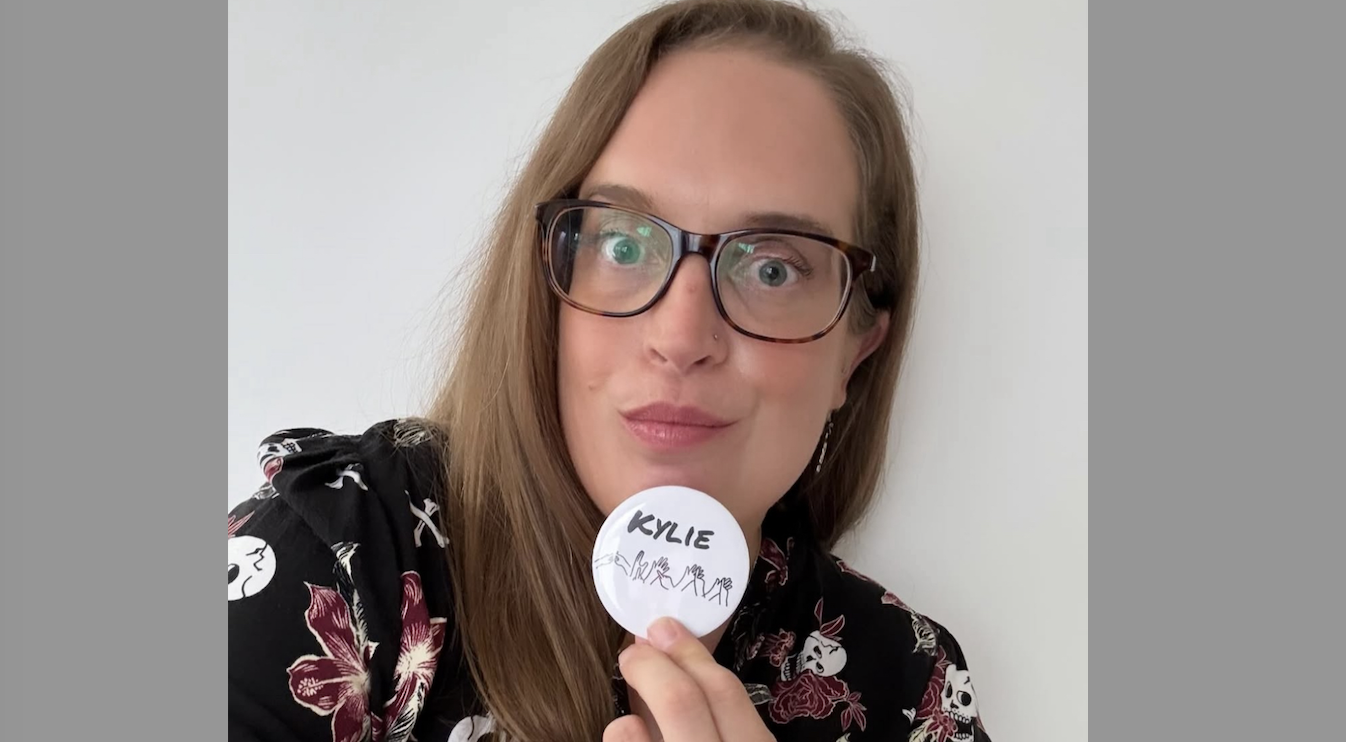
Hi everyone, I’m Kylie and I’m an Early Years Educator based in Cambridgeshire. I founded Badge Religion – a range of BSL badges – earlier this year.
My connection to deafness is through my daughter, Eva (12). She failed her newborn hearing screening, and I was initially told this could be due to her being born via C-section. But after further follow-up tests, we learned she had moderate to severe hearing loss.
Eva was later diagnosed with Sticklers Syndrome, a condition that affects the collagen gene, with deafness being one of its symptoms.
Becoming a parent to a deaf child completely changed the way I saw communication, inclusion and accessibility, something that has directly influenced everything I now do with Badge Religion.
When Eva was first diagnosed, it was an overwhelming time. As a hearing parent, I didn’t have any lived experience of deafness, so everything felt completely new.
I went from being told her failed newborn screening was probably nothing to worry about, to sitting in follow-up appointments hearing the words “moderate to severe hearing loss.” It was a huge emotional shift, I felt shocked, protective, and honestly a bit lost at first.
My initial concerns were all the things parents worry about: how she would communicate, what support she would need, and whether she would feel included and understood as she grew up. When her Sticklers Syndrome diagnosis followed, it added another layer to navigate, and there was a lot to take in.

Eva was a confident, bubbly toddler, full of personality and absolutely determined from the very beginning. But when she was little, despite her diagnosis, we were never offered the option to learn sign language.
Instead, we were repeatedly told that signing would interfere with her ability to learn to speak. We now know this isn’t true. In fact, studies show that signing supports language development rather than hinders it, but that simply wasn’t the advice we were given at the time.
As a young child Eva particularly fussed about her hearing aids. She just accepted them as part of her routine. But as she got older, and became the only hearing aid user in her school, she became much more aware of her differences.
Unfortunately there were some unkind comments from other children, and that understandably affected her confidence. Her hearing aids became something she resented, and getting her to wear them became a real battle.
That was when we made the decision to move her to a Deaf Support Centre within a mainstream school, so she could be around adults and peers who used the same equipment and shared similar experiences. The moment she started at the new school, everything changed.
Within weeks, her confidence grew. She began to develop a strong deaf identity, surrounded by people who understood her world. She also started learning BSL, and it opened up so many opportunities.
Suddenly Eva could communicate in busy, noisy environments where she would have previously been excluded. Watching that shift, seeing her feel seen, included, and proud, was one of the biggest turning points for us as a family.
BSL came so naturally to Eva. Signing gave her a way to communicate in situations where spoken language simply didn’t work, busy classrooms, noisy playgrounds, group activities, or moments when she was tired and listening became too much.
For the first time, she had a communication method that didn’t rely on straining to hear. It was empowering for her, and you could see how proud she was each time she learned something new.
As a family, we were incredibly excited for her, but there was also a sense of frustration. Accessing BSL as hearing parents of a deaf child wasn’t easy at all. Courses were limited, expensive, or had waiting lists, and it often felt like we were fighting to keep up with her.
We took part in a family course run by the Cambridge and Huntingdon Deaf Children’s Society, which made a huge difference. I’ve also paid for additional courses so we could continue learning alongside her and support what she was doing at school.
BSL has strengthened our communication as a family and helped us stay connected to Eva in environments where she might otherwise have felt isolated. It’s given her confidence, identity, and independence, and for us as her parents, it’s given us a way to meet her in her world, not just expect her to adapt to ours.
The idea for designing BSL badges started very simply. As a parent of a deaf child, and after watching Eva learn BSL, I became passionate about making sign language more visible and accessible.
I wanted something small, meaningful and eye-catching that could spark conversations, something that would encourage people to ask, “What does that sign mean?” or “Why are you wearing that?”
I wanted to create designs that celebrate BSL, raise awareness, and help normalise deaf identity in everyday spaces. Each badge is handmade by me, from the initial design right through to cutting, pressing and packaging.

It’s my way of promoting BSL while also raising money for the Cambridge and Huntingdon Deaf Children’s Society, who have supported our family so much.
The name Badge Religion came from a simple play on words. I love a good pun, and I’m also a big fan of punk music. There’s a band called Bad Religion, and one day I jokingly switched it to “Badge Religion.” It made me smile, it felt memorable, and it captured my love of badges perfectly, so the name stuck.
I originally made a few BSL name badges for my own work lanyard, for Eva’s school bag, and for my niece and nephew’s bags. I shared a photo on my personal social media, not thinking much of it, but the response was incredible. Friends began asking for their own badges, and that’s when I realised I might be onto something.
I reached out to Claire at the Cambridge and Huntingdon Deaf Children’s Society to ask if I could donate a percentage of the profits from badge sales to the charity. She was so supportive, and that gave me the confidence to take the next step. I shared the badges on the Badge Religion page in July 2025, and from there it just snowballed.
No business plan, no research, just an idea that grew faster than I ever expected, powered by support from the deaf community, parents, teachers and people who wanted to champion BSL.
What started as a small idea has grown into something that seems to genuinely resonate with people. I’ve had messages from parents, teachers, TAs, support staff, healthcare professionals and members of the deaf community telling me how much the badges mean to them.
People often tell me the badges spark conversations, a child asking what their teacher’s badge means, or a colleague recognising a BSL sign and starting to learn themselves. That’s exactly what I hoped they would do: make BSL visible, normal and approachable.
I’ve also had a lot of emotional messages from parents of deaf children who say the badges help their child feel seen and represented. That’s incredibly special to me.
The support has been so strong that I’ve now made over 250 badges since July. For a one-woman project that started on my sofa, it’s been amazing to see how far the badges have travelled and how many people they’ve reached.
The badges might look small, but their impact can be huge, especially for deaf children and their families. One of the biggest challenges deaf children face is visibility and understanding. The badges help bridge that gap.
When teachers, TAs, family members or peers wear BSL badges, it sends a message that deaf awareness matters and that communication isn’t a one-way street.
I’ve had parents tell me their child’s face lights up when they see someone wearing a badge with their initial in BSL, or that it makes them feel proud of their deaf identity rather than different.
The badges also spark conversations. Children ask what the sign means, adults become curious, and suddenly BSL becomes part of everyday interactions. That kind of visibility helps reduce stigma, encourages inclusion, and makes environments more accessible.
I wish more parents knew that deafness is not something to be afraid of. It can feel overwhelming at first, there’s so much information, so many appointments, and a lot of emotions to process, but your child is still the same amazing little person they were the day before the diagnosis.
I also wish families were told earlier about the benefits of sign language. Signing doesn’t replace spoken language, it adds to it. It gives children access to communication in moments where listening is tiring, difficult or impossible. I would encourage any parent to explore sign language early, even if you’re unsure where it fits yet.
Everything I do, from learning BSL to creating Badge Religion, is rooted in wanting Eva to grow up in a world where she feels seen, included and proud. If she grows up knowing her worth, her identity and her community, then she’ll have everything she needs to thrive.
You can find Badge Religion online.

This blog was edited by Assistant Editor Rebecca A Withey. If you have a story or experience you’d like to share on our site, get in touch at rebecca@rawithey.com
Enjoying our eggs? Support The Limping Chicken:

The Limping Chicken is the world's most popular Deaf blog, and is edited by Deaf writer and photographer Charlie Swinbourne.
Our posts represent the opinions of blog authors, they do not represent the site's views or those of the site's editor. Posting a blog does not imply agreement with a blog's content. Read our disclaimer here and read our privacy policy here.
Find out how to write for us by clicking here, and how to follow us by clicking here.
This site exists thanks to our supporters. Check them out below:
- Lumo TV: TV programmes in BSL for the Deaf community
- Bellman & Symfon: home alerting solutions, including the mobile phone transceiver!
- SignVideo: Instant BSL video interpreting online
- British Deaf Association: Working to transform the way BSL is accessed in the UK
- 999 BSL: call 999 in an emergency, in BSL
- Deaf Umbrella: Making colleges and workplaces more accessible
- Appa: Looking for RSLIs, TSLIs and CSWs, apply here!
- Signly: Adding BSL to websites
- Signworld: Learn BSL online!
- DCAL: world-class research into deafness, cognition and language
- Lipspeaker UK: specialist lipspeaking support
- BID: Deaf services, including advice and support, interpreting, employment and letters
- Interpreting Matters: BSL interpreting agency
- Sign Solutions: Instant access to Interpreters, training and BSL translation nationwide
- InterpretersLive: On demand BSL video interpretation
- Performance Interpreting: BSL interpreting at concerts
- National Deaf Children's Society: The leading charity for deaf children
- Action Deafness: “A Deaf-Led Charity” – interpreting & community support services





Posted on November 28, 2025 by Rebecca A Withey