
In the mid 1980s I signed a publishing contract with Book Publisher A for my autobiography about deafness, which I titled The Dragonfly. It had a subtitle with the word ‘deaf’ in it somewhere so it wouldn’t end up in the entomological sections of libraries and bookshops. So far, so good.
Then Book Publisher A was swallowed whole by much bigger Book Publisher B. These good people did not want to publish The Dragonfly, and suggested I look elsewhere. But we have a contract, I told them. They got a bit sniffy, said they were only trying to help.
Barry, my solicitor, sent BP B one of those kindly threatening letters in the way only solicitors can do. “We’ll tear up the contract if you compensate my client,” he wrote. They eventually did, for $3000, or as I told people at the time, I won a six-figure settlement (if you count the cents).
Barry later told me they actually threatened to publish. They would do a minimum print run on cheap paper stock hardly better than toilet paper, not bother with book design or marketing, bung the lot into a warehouse and congratulate themselves because technically they’d met their side of the contract.
The experience was an apt demonstration of the quirkiness of deafness as a publishing topic. For almost all literary gatekeepers, deafness raises the faintest of eyebrows before vanishing forever.
I’d often thought that The Dragonfly was terrible, and $3000 was a lot more than anything I might earn from royalties. I now think it was the Universe telling me: You need more time for your writing to develop. Here’s three grand. Now get going.
I did and it has. After a few decades I’ve written opinion pieces on deaf politics, a few regular columns, blogs, reviews, a few short stories, a novella, and comedy material on disability politics for a community television series.
I’ve co-authored academic articles and book chapters. Parody and humour have been a feature; I had a lot of fun with a short piece of erotica into which I crammed as many words as I could from an IKEA catalogue. I founded and edited a community newspaper on disability, now the subject of my present novel.
I’ve worked in journalism as an editor and subeditor on newspapers and magazines, and written two novels, with another well on the way. I’m working on a play and I even wrote a couple of birthday sonnets in iambic pentameter.
Quite a lot of my work has been published in both print and online, but the long-form works have so far just failed to attract agent and publisher interest. I’ve started to pick up some awards: a mentorship here, a writers’ travel grant there, a highly commended here, a long-listing there. Most of my output, but not all of it, has been on deafness.
The best writing advice I’ve had? Just five words from the Australian writer Helen Garner: “Go easy on the adverbs.” And also, in just two words, from another Australian writer and my colleague, Lyndel Caffrey: “Be bold”.
I realised that to attract reader and publisher interest I needed to hitch the little trolley of deafness to one of the locomotives of major social issues. I began with a play which explored what deafness has in common with feminism.
Both are misunderstood, both cope with damaging stereotypes, both have problems with language, and both attract opprobrium. My play had flashes of merit but was let down by virtuous psychobabble like “I felt your pain”.
More recently I’ve amplified this idea by taking popular cultural figures and making them deaf. And so, short pieces on my website reveal Star Wars’ Luke Skywalker, the consulting detective Sherlock Holmes, Adam from the Garden of Eden, and others, all finding themselves deaf. What would happen? As it turned out, unpredictability and hilarious confusion.
In the vast heaving ocean of major social issues all competing for attention, clicks and prominence, deafness is a tiny tadpole. In literature, why does deafness remain vanishingly obscure? Could you trace it back to the Bible?
The story of Christ curing the deaf-and-dumb man tells me two things. The first is that there is nothing new about deafness; it’s been around for millennia. In the contest for new ideas, perspectives, slants, and new ways of thinking, deafness has no hope.
The second is that deafness can be cured. If deaf people can be undeafed, then what’s all the fuss? Why bother with it? And especially, what’s the point of writing about it?
This idea of a cure for deafness never really goes away. It dusted itself off and re-emerged during the 1980s as the marketing and promotion of the new cochlear implant took hold.
It’s ironic that they were saying much the same thing one hundred years earlier in a London Times story in which an overexcited correspondent claimed that “deafness is abolished”. This was in a report on the Congress of Milan, the 1880 gathering of European clerics and educators of deaf children which turbocharged oralism and spread it around the world.
That deliberate attempt to wipe out a language is a story that cries for a retelling, and this time, from the deaf point-of-view. In When the Mind Hears, Harlan Lane described what actually happened. In my fictionalised account of this Congress, ‘Why do they Hate us So?’, I wrote how it might have happened. My story appeared in a few anthologies. It now forms the opening of my deaf history novel, set in Italy and in Britain before moving to Australia.
Meanwhile my original Dragonfly expanded and shrunk. Over the years it became better and better, and became two memoirs. I had them professionally edited and self-published both. Speaking at the launch, the Australian writer Arnold Zable said some of my writing reminded him of Franz Kafka. That was quite a moment, and what a great honour for Mr Kafka to be compared to me.
In spite of repeated attempts to eradicate deafness, writing about it continues to endure. Right now, there may be a gentle resurgence. For my own works, serendipity – being in the right place at the right time with the right person – might be my friend.
The dragonfly is my totem animal. It’s impressive watching a dragonfly in flight. They swoop, soar, hover and dart sideways. They move so fast they seem to vanish, but they’re never far away. They are an apt metaphor for the way I survive the communication maelstrom among the hearing, and for me, they capture a little of what good writing is about.
Good writing about deafness follows the same rules as good writing about anything else. That should be obvious, but it has a particular resonance for deafness, because in the end, deafness becomes an attitude. It takes rat-cunning to survive in a world that barely recognises deafness. So, are you going to write about it? Don’t give up, and above all, be bold.
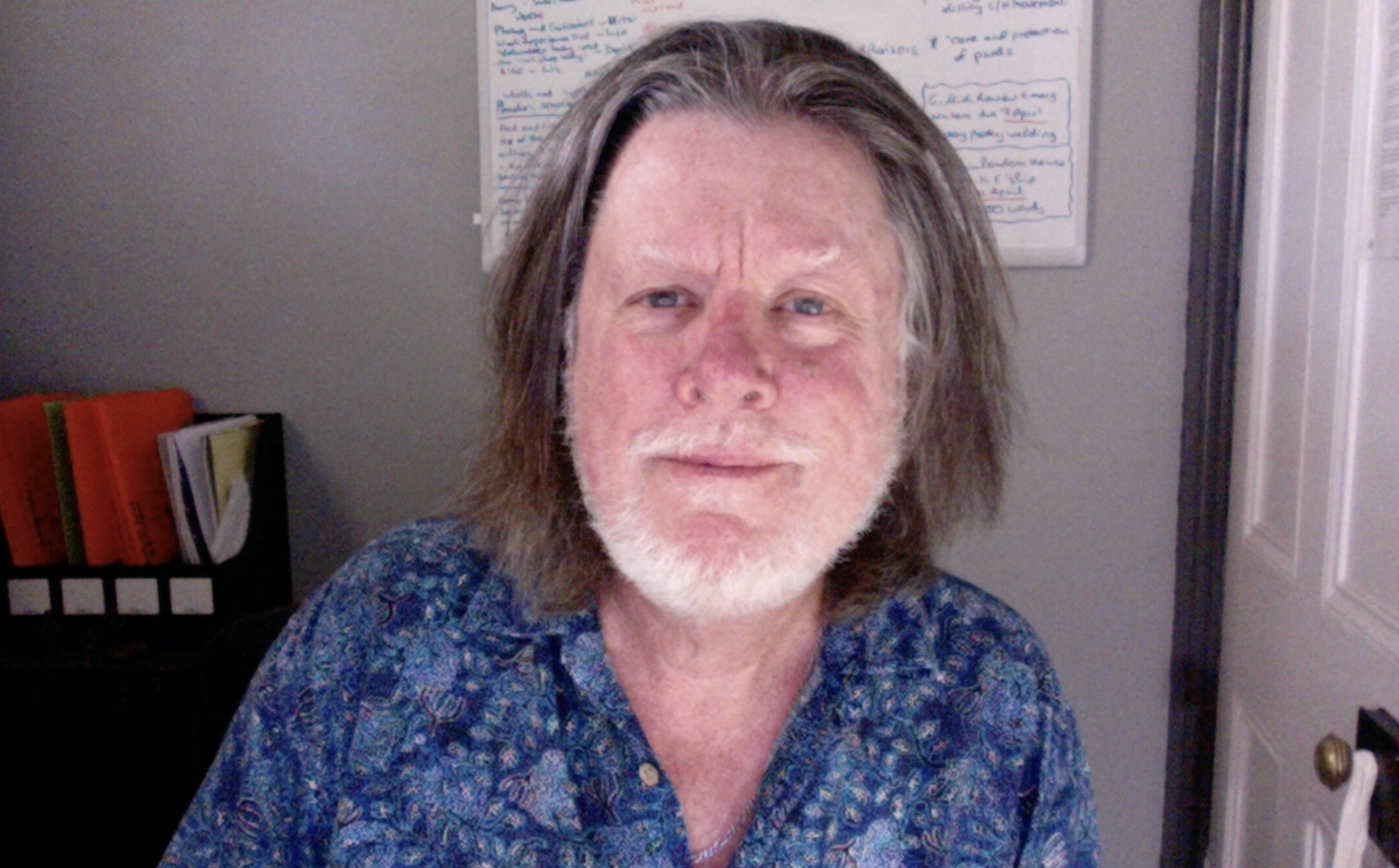
Michael Uniacke lives in Castlemaine in Victoria, Australia. He writes frequently on deafness, disability and hearing impairment. His memoirs Deafness Down and Deafness Gain are available from most online bookstores, and his website is at www.tuq.pub Email to theunguardedquarter@gmail.com.
Enjoying our eggs? Support The Limping Chicken:

The Limping Chicken is the world's most popular Deaf blog, and is edited by Deaf writer and photographer Charlie Swinbourne.
Our posts represent the opinions of blog authors, they do not represent the site's views or those of the site's editor. Posting a blog does not imply agreement with a blog's content. Read our disclaimer here and read our privacy policy here.
Find out how to write for us by clicking here, and how to follow us by clicking here.
This site exists thanks to our supporters. Check them out below:
- Lumo TV: TV programmes in BSL for the Deaf community
- Bellman & Symfon: home alerting solutions, including the mobile phone transceiver!
- SignVideo: Instant BSL video interpreting online
- British Deaf Association: Working to transform the way BSL is accessed in the UK
- 999 BSL: call 999 in an emergency, in BSL
- Deaf Umbrella: Making colleges and workplaces more accessible
- Appa: Looking for RSLIs, TSLIs and CSWs, apply here!
- Signly: Adding BSL to websites
- Signworld: Learn BSL online!
- DCAL: world-class research into deafness, cognition and language
- Lipspeaker UK: specialist lipspeaking support
- BID: Deaf services, including advice and support, interpreting, employment and letters
- Interpreting Matters: BSL interpreting agency
- Sign Solutions: Instant access to Interpreters, training and BSL translation nationwide
- InterpretersLive: On demand BSL video interpretation
- Performance Interpreting: BSL interpreting at concerts
- National Deaf Children's Society: The leading charity for deaf children
- Action Deafness: “A Deaf-Led Charity” – interpreting & community support services




Posted on February 6, 2026 by Rebecca A Withey