
A deaf-led access charity, Stagetext, has secured £183,356 from the Creative Foundations Fund, part of the government’s Arts Everywhere Fund, to expand access to captioned theatre performances across the UK. The funding will support a new three-year project launching this month, focused on renewing captioning equipment and establishing a network of twelve hub venues across England.
Each hub will be equipped with captioning technology to share with neighbouring theatres, with the aim of reaching up to 36 venues nationwide and significantly increasing the number of captioned performances available to deaf audiences.
The investment responds to a clear and growing demand. An estimated 18 million adults in the UK are deaf, deafened or hard of hearing—around one in three potential theatre-goers—yet most theatres currently caption only a small number of performances per run, and those tickets often sell out quickly. Stagetext says this lack of provision has long limited choice for deaf audiences, particularly outside London.
The charity, founded in 2000, now supports more than 1,000 captioned performances and live subtitled events each year—on average three every day—and provides deaf awareness and accessibility training to arts and cultural organisations. However, around half of its current captioning work still takes place in London, something the organisation is keen to change.
Chief Executive Melanie Sharpe described the funding as a major step forward, saying,
“We are over the moon to receive the funding… deaf, deafened and hard of hearing people have told us they want more choice and for captioning to be available in smaller theatre spaces and at regional venues.”
She added that the investment would allow Stagetext to support more theatres to deliver captioning themselves, while also strengthening the infrastructure needed to meet rising demand, calling it “a huge milestone… to provide more deaf access to arts and culture across the UK.”
For audiences, the impact of captioning can be transformative, but access remains inconsistent. Caption users say that while subtitles have opened up theatre in a meaningful way, opportunities to attend accessible performances are still too limited.
One user described captioning as “transformational… but it’s so frustrating that there are so few shows with deaf access,” adding that the expansion of provision beyond London “will change so many people’s lives.”
The expansion of captioning provision through this project is expected to make a significant difference, not only by increasing the number of performances available but also by widening their geographic spread beyond major cities.

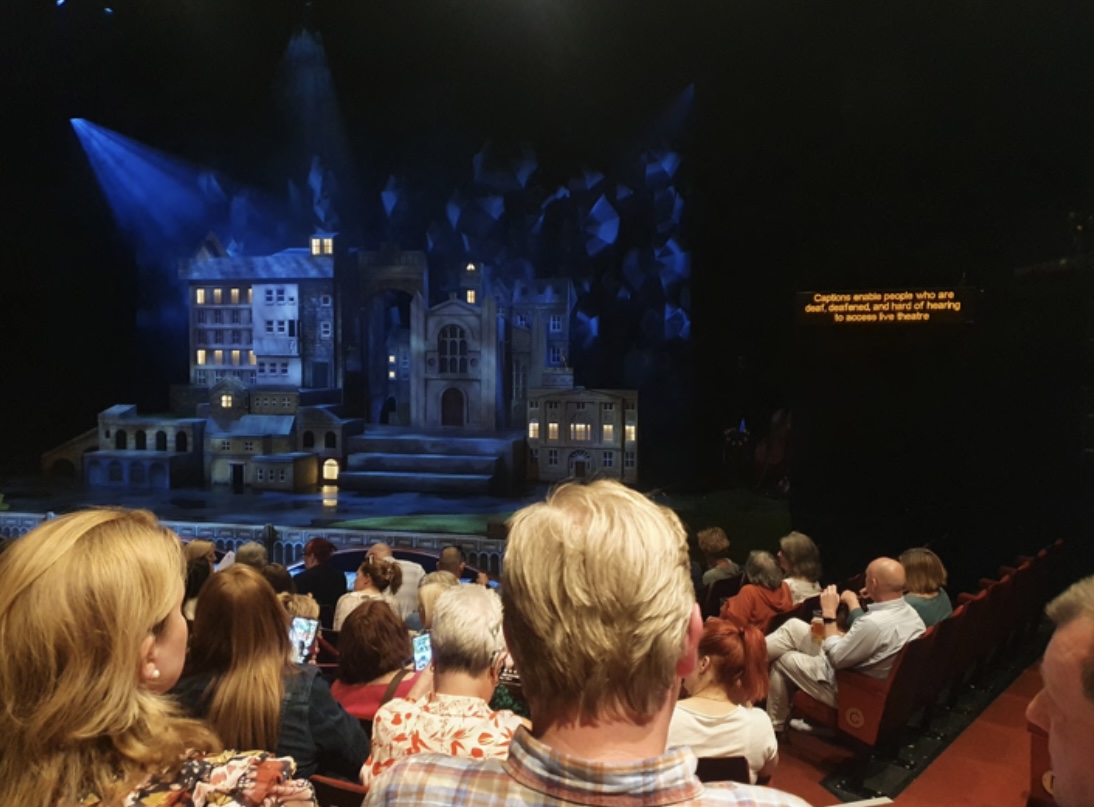
Much Ado, Theatre Royal Drury Lane, Malachy Luckie
One of the twelve hub venues will be the Mercury Theatre in Colchester, which will work closely with Stagetext to expand its accessible programme. The theatre plans to increase the number of captioned shows it offers and, for the first time, provide accessible performances across both its main stage and studio spaces at the same time.
It will also take on a regional leadership role, supporting other venues in the East of England by sharing equipment, offering training, and helping to build local capacity for captioning.
This includes developing new captioners in the region and encouraging more theatres to include captioned performances and events in their programming, with the theatre saying it is “particularly looking forward to working in partnership with Stagetext to increase the captioned shows we can offer.”
The funding awarded to Stagetext is part of a wider £6.6 million investment across 12 cultural venues, museums and libraries in the East of England, and one of 130 grants announced nationally. The programme aims to strengthen buildings, equipment and infrastructure across the arts and heritage sectors, ensuring organisations are better equipped to serve their communities.
The government says the Arts Everywhere Fund is designed to increase access to culture while protecting it for future generations. Lisa Nandy highlighted the importance of cultural organisations as part of local identity and community life, saying,
“Arts and culture are the beating hearts of our communities… they have the power to unite us… and break down barriers to opportunity.”
She added that the funding demonstrates a commitment to supporting cultural assets across the country and ensuring more people can take part, regardless of where they live.
Arts Council England, which is supporting the funding programme, said the investment would help cultural organisations modernise facilities, safeguard important spaces and adapt to changing needs.
The organisation emphasised that strengthening infrastructure is key to ensuring long-term sustainability, while also improving accessibility for audiences.
For Stagetext, the funding represents both a practical and symbolic milestone—providing the resources to expand captioning provision while signalling wider recognition of the importance of accessibility in the arts.
By building a network of shared equipment and expertise, the charity hopes to make captioned performances a more routine part of theatre programming.
As the project begins, the focus will be on collaboration between venues, developing local skills and embedding captioning across more parts of the sector.
For deaf, deafened and hard of hearing audiences, the outcome could be a significant shift: more choice, more flexibility, and more opportunities to experience live performance.
For more information about Stagetext see their website here.
Enjoying our eggs? Support The Limping Chicken:

The Limping Chicken is the world's most popular Deaf blog, and is edited by Deaf writer and photographer Charlie Swinbourne.
Our posts represent the opinions of blog authors, they do not represent the site's views or those of the site's editor. Posting a blog does not imply agreement with a blog's content. Read our disclaimer here and read our privacy policy here.
Find out how to write for us by clicking here, and how to follow us by clicking here.
This site exists thanks to our supporters. Check them out below:
- Lumo TV: TV programmes in BSL for the Deaf community
- Bellman & Symfon: home alerting solutions, including the mobile phone transceiver!
- SignVideo: Instant BSL video interpreting online
- British Deaf Association: Working to transform the way BSL is accessed in the UK
- 999 BSL: call 999 in an emergency, in BSL
- Deaf Umbrella: Making colleges and workplaces more accessible
- Appa: Looking for RSLIs, TSLIs and CSWs, apply here!
- Signly: Adding BSL to websites
- Signworld: Learn BSL online!
- DCAL: world-class research into deafness, cognition and language
- Lipspeaker UK: specialist lipspeaking support
- BID: Deaf services, including advice and support, interpreting, employment and letters
- Interpreting Matters: BSL interpreting agency
- Sign Solutions: Instant access to Interpreters, training and BSL translation nationwide
- InterpretersLive: On demand BSL video interpretation
- Performance Interpreting: BSL interpreting at concerts
- National Deaf Children's Society: The leading charity for deaf children
- Action Deafness: “A Deaf-Led Charity” – interpreting & community support services




Posted on April 16, 2026 by Rebecca A Withey