
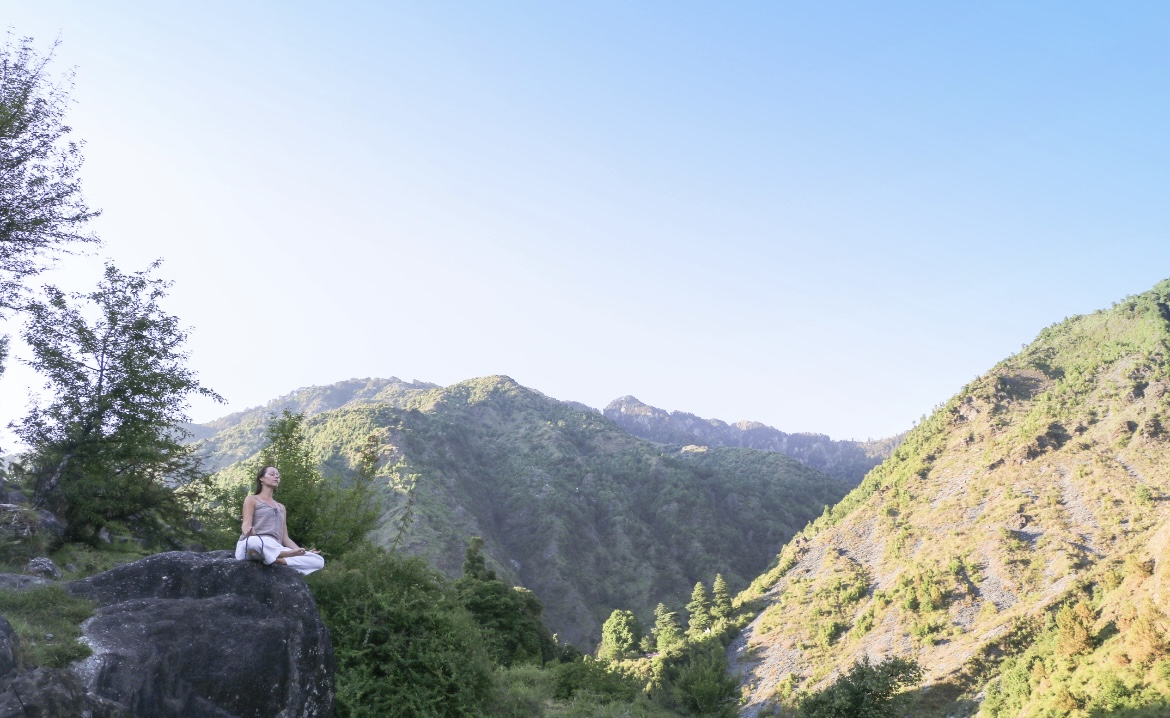
Laura at Mango Wisdom Wellness is a CODA (Child of Deaf Adults) who now lives in Goa, India where she has spent the last decade combining her passions for yoga, Ayurveda, wellbeing and community development.
Alongside running retreats and teaching classes, Laura is committed to making yoga more accessible for Deaf people through BSL-friendly teaching, small group retreats and tailored wellbeing programmes.
In this article, Laura reflects on growing up between Deaf and hearing worlds, her unexpected journey into yoga, life in India, and why she believes wellbeing practices should be accessible to everyone
Growing up as a CODA
I grew up in the UK, in a small town called Hertford. As a CODA, I was very aware of inequality from a young age and often found myself navigating between the Deaf and hearing worlds. It could feel strange at times, belonging to both worlds yet not fully fitting into either of them.
Those experiences shaped who I am. They taught me independence, empathy, adaptability, and a strong sense of justice. From a young age, I wanted to help people and make a difference where I could.
Like many CODAs, I became very good at putting other people’s needs first. This has been both a blessing and a challenge. Supporting others comes naturally to me, but over the years I have learned the importance of balance. Through Yoga, Ayurveda, and personal growth, I have learned that I must first take care of myself and keep my own battery charged before I can effectively support others.
Looking back, being a CODA has influenced almost every aspect of my life. It has shaped my values, my work, and my passion for creating inclusive spaces where people feel seen, understood, and supported.
Discovering Yoga
I first discovered Yoga at my local gym in the UK about 25 years ago. At the time, I was a complete gym bunny and much more interested in fast, intense workouts than Yoga.
About 15 years ago, when I left the UK to travel around Asia, I took a Yoga mat with me and began practising regularly. Over time, the practice became about much more than physical fitness. It helped me connect with my inner world, and during those early months I had a strong feeling that I needed to come to India and complete my Yoga Teacher Training.
It took some time to make that happen, but 11 years ago I returned to India and completed 500 hours of Yoga Teacher Training. Interestingly, I now work with the same teacher who trained me all those years ago.
Although I have been fortunate to learn from many wonderful teachers, I would say the greatest encouragement on my path has come from within.

Why India?
India was calling me from a very young age. I always had a strong feeling that I would live here one day.
Living in India and embodying the teachings of Yoga and Ayurveda has transformed me. It has taught me humility, patience, gratitude, and how to see the bigger picture in life. India has taught me that every experience, whether pleasant or challenging, carries a lesson. Rather than getting stuck in what happened, we can accept it, learn from it, and move forward.
I also love the connection to nature and the simpler way of life. I spend every day surrounded by the natural beauty of Goa, living close to the jungle and the sea. Two Indie dogs adopted me six years ago, and we’ve been a happy family ever since.
I would love more people to know that India is far more than a destination. It is a place that can inspire deep self-reflection, personal growth, gratitude, and a deeper connection with both nature and yourself.
Making Yoga accessible for deaf people
Accessibility can be a challenge. There is plenty of information available through books, but most people benefit from the support and guidance of a qualified teacher on their Yoga journey.
When teaching Deaf people, I adapt my classes to make them as accessible as possible. I teach in sign, cue positions ahead of time, use lots of repetition, and plan many seated sequences where participants and I can remain face to face. I often use a five-count breath to stay in postures, allowing participants time to focus on their own experience of the pose rather than constantly watching for the next instruction.
It takes time for people to feel confident enough to close their eyes and trust their own breath count, so I reassure participants that I will wait for everyone. I am constantly observing the group, which is one of the reasons I keep my classes small.
I am always learning and welcome feedback from participants. Over the years I have adapted many techniques to suit a Deaf audience, including body scanning through touch, follow-up notes by email, illustrated handbooks showing postures and sequences, and recordings of classes for people to revisit in their own time.
Retreats, Classes and Holistic Wellbeing
I currently offer online Yoga classes and work one-to-one with clients as a spiritual mentor, health coach, and holistic counsellor. Using the wisdom of Yoga and Ayurveda, I support people who would like to improve their health, deepen their spirituality, or navigate life’s challenges in a more balanced and conscious way.
Most of my retreats take place in India and are designed to give guests an authentic experience of both Yoga and Indian culture. Alongside twice-daily Yoga classes, participants enjoy Ayurveda workshops, vegetarian food, time in nature, and opportunities to explore the local area.
In short, guests can expect to experience the real India, enjoy healthy food, relax in nature, learn practical tools for wellbeing, and return home feeling refreshed, inspired, and rejuvenated.

Advice for deaf people thinking about yoga
For Deaf people who are interested in trying yoga, I would encourage them to start with a conversation. They are welcome to book a free half-hour chat with me so that we can get to know each other, discuss any concerns, and see whether we are a good fit.
After that, I would usually offer a free taster class so they can experience yoga for themselves without any pressure or commitment.
In my experience, most people do not stay nervous for long. Yoga is not about being flexible, fit, or getting everything right. It is simply about meeting yourself where you are.
One of the most important things is to let go of comparison. Yoga is not a competition, and everybody’s body, life experience, and journey are different. The practice is about developing a relationship with yourself, not trying to be like somebody else.
Advice for yoga teachers
Firstly, remember that many Deaf people need to see your face and lips clearly when delivering instructions, so avoid speaking while facing away from the class. Good lighting and clear visibility are essential.
Secondly, slow down. There is no rush. Allow time for information to be processed and understood before moving on.
Finally, create a safe and welcoming environment. Some students may feel emotional during yoga practice, particularly if they are connecting with their bodies in a new way. Be gentle, avoid making assumptions, and take time to build trust before offering hands-on adjustments or detailed corrections.
Looking ahead
My next Deaf Yoga and Ayurveda Retreat will take place in Goa in November 2026, and I am very much looking forward to welcoming another group to experience the beauty of India, Yoga, Ayurveda, and nature together.
I am also working on new online courses to make Yoga, Ayurveda, and holistic wellbeing more accessible to Deaf people, allowing participants to learn and practise at their own pace from home.
For me, the deeper purpose of Yoga and Ayurveda is to remain aware, present, and connected to who we truly are, both on and off the mat.
You can find out more about Laura and her work here.
Enjoying our eggs? Support The Limping Chicken:

The Limping Chicken is the world's most popular Deaf blog, and is edited by Deaf writer and photographer Charlie Swinbourne.
Our posts represent the opinions of blog authors, they do not represent the site's views or those of the site's editor. Posting a blog does not imply agreement with a blog's content. Read our disclaimer here and read our privacy policy here.
Find out how to write for us by clicking here, and how to follow us by clicking here.
This site exists thanks to our supporters. Check them out below:
- Lumo TV: TV programmes in BSL for the Deaf community
- Bellman & Symfon: home alerting solutions, including the mobile phone transceiver!
- SignVideo: Instant BSL video interpreting online
- British Deaf Association: Working to transform the way BSL is accessed in the UK
- 999 BSL: call 999 in an emergency, in BSL
- Deaf Umbrella: Making colleges and workplaces more accessible
- Appa: Looking for RSLIs, TSLIs and CSWs, apply here!
- Signly: Adding BSL to websites
- Signworld: Learn BSL online!
- DCAL: world-class research into deafness, cognition and language
- Lipspeaker UK: specialist lipspeaking support
- BID: Deaf services, including advice and support, interpreting, employment and letters
- Interpreting Matters: BSL interpreting agency
- Sign Solutions: Instant access to Interpreters, training and BSL translation nationwide
- InterpretersLive: On demand BSL video interpretation
- Performance Interpreting: BSL interpreting at concerts
- National Deaf Children's Society: The leading charity for deaf children
- Action Deafness: “A Deaf-Led Charity” – interpreting & community support services




Posted on June 17, 2026 by Rebecca A Withey