
As a deaf BSL user, I’m used to advocating for access.
Whether it’s asking for captions, booking an interpreter or reminding someone to face me when they speak, it’s become part of everyday life. It can be exhausting, but it’s also something I’ve learnt to expect.
What I wasn’t expecting during a recent trip to Edinburgh was to feel, for a little while, as though I’d stepped back in time.
I travelled to Scotland with a friend, who was also interpreting for me, to attend a weekend seminar with around 1,400 people from 54 different countries.
Now, even before we arrived, the cracks in accessibility were beginning to show. A mere half hour into our train journey from the Midlands, an announcement was made that the train would now terminate at Newcastle. Had I been travelling alone, I wouldn’t have known this.
There was no accessible notification through the train app, just announcements made over the tannoy.
When we reached the platform in Newcastle, there were more spoken announcements but very little visual information. Eventually my friend found a member of staff, whose advice was simply to “get on the next available train.”
It wasn’t the best start to the weekend.
And when we arrived at the venue the following morning, something felt very… off.
We sat in the café before the event began, chatting in sign language over brunch while the other attendees gathered around us.
People looked. Then quickly looked away again. Nobody smiled. Everyone seemed to keep to themselves.
It wasn’t openly hostile, but there was an awkwardness in the air that I couldn’t quite put my finger on. It reminded me of years gone by, when deaf people were more of a curiosity than something people encountered in everyday life.
Inside the auditorium, things didn’t get much better.
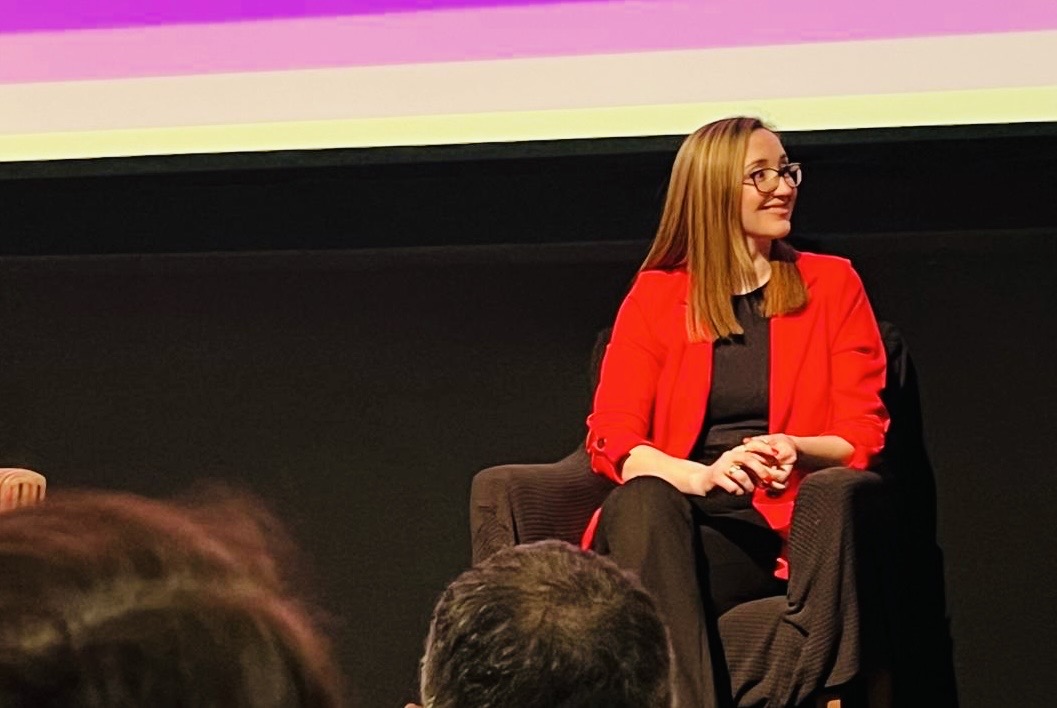
The organisers had reserved accessible seating for me, but unfortunately I had been placed at the far end of a row, making it almost impossible for me to comfortably watch both the speaker and my interpreter.
My interpreter’s chair had also been placed directly in front of mine, facing me—so close she could probably have sat on my lap.
When I asked whether we could both move somewhere more central, the initial answer was no because everyone had already been seated. Later, I discovered another reason. They didn’t want my interpreter appearing in the event camera shots.
I explained to the organisers that equal access meant being able to see both the speaker on stage and my interpreter, and to their credit, they agreed to allow the interpreter to move a little closer to the stage and promised that they would review my seating for the following day.
Throughout the first day, people repeatedly walked between me and my interpreter while she was signing, completely blocking my view. One woman even questioned why my interpreter was facing “the wrong way”.
Nobody spoke to us and we both felt strangely isolated from the rest of the room. So, by the time we got back to our Airbnb that evening, I felt disappointed.
Not just because of the access issues, but because I couldn’t shake the feeling that we’d somehow gone backwards.
Then came day two.
The organisers kept their promise and moved us to a much better position. But what surprised me most wasn’t the improved seating. It was the people.
The same woman who had sat quietly beside us in the café the previous day suddenly struck up a conversation once she realised I could lipread and there was a way we could communicate.
Back at the seminar, I decided to make an effort to say hello to the people sitting around me.It was a small gesture, but it seemed to break the ice.
Before long, I was chatting with delegates who had travelled from all over the world. One woman from Spain spoke very little English, but we still managed to communicate through gestures. She pointed to her scarf and mimed shivering. Then she revealed she was wearing thermals under her top. In July!
Two other delegates also approached my interpreter. They weren’t questioning why she was there anymore. They were simply curious about her job.
They wanted to know how difficult it was to interpret such a fast-paced speaker. They asked what language we were using and how interpreting worked. The atmosphere had completely changed.
On the first day, I’d found myself wondering why everyone seemed so distant. By the second day, I felt relaxed enough to simply be myself and make the first move.
Perhaps we’d all needed a little time to get used to one another!
Nothing about me had changed overnight. The only difference was that people now understood why my interpreter was there. That’s when I came to the realisation that I had been guilty of making an assumption:
I had mistaken unfamiliarity for unfriendliness.
That doesn’t mean the access issues didn’t matter. Organisers should be thinking about accessibility from the very beginning, not waiting for us to point out what’s missing.
Nor should I have had to explain why I needed to see both the speaker and my interpreter, just as I shouldn’t have had to rely on someone else to tell me my train had been cancelled.
But my weekend in Edinburgh reminded me that many hearing people simply don’t have Deaf people in their lives.
They aren’t deliberately excluding us or being rude. Often, they just haven’t had the opportunity to learn.
I know that doesn’t excuse poor accessibility. Organisations still have a responsibility to get that right from the outset. But when it comes to people, I left Edinburgh with a different perspective.
Sometimes, people just need the chance to understand.
And that goes for me, too.
By Rebecca A Withey
Rebecca A Withey is the Assistant Editor for The Limping Chicken. She is also a freelance writer, BSL consultant and creative artist based in the Midlands. Rebecca is a Deaf, bilingual BSL user.
Enjoying our eggs? Support The Limping Chicken:

The Limping Chicken is the world's most popular Deaf blog, and is edited by Deaf writer and photographer Charlie Swinbourne.
Our posts represent the opinions of blog authors, they do not represent the site's views or those of the site's editor. Posting a blog does not imply agreement with a blog's content. Read our disclaimer here and read our privacy policy here.
Find out how to write for us by clicking here, and how to follow us by clicking here.
This site exists thanks to our supporters. Check them out below:
- Lumo TV: TV programmes in BSL for the Deaf community
- Bellman & Symfon: home alerting solutions, including the mobile phone transceiver!
- SignVideo: Instant BSL video interpreting online
- British Deaf Association: Working to transform the way BSL is accessed in the UK
- 999 BSL: call 999 in an emergency, in BSL
- Deaf Umbrella: Making colleges and workplaces more accessible
- Appa: Looking for RSLIs, TSLIs and CSWs, apply here!
- Signly: Adding BSL to websites
- Signworld: Learn BSL online!
- DCAL: world-class research into deafness, cognition and language
- Lipspeaker UK: specialist lipspeaking support
- BID: Deaf services, including advice and support, interpreting, employment and letters
- Interpreting Matters: BSL interpreting agency
- Sign Solutions: Instant access to Interpreters, training and BSL translation nationwide
- InterpretersLive: On demand BSL video interpretation
- Performance Interpreting: BSL interpreting at concerts
- National Deaf Children's Society: The leading charity for deaf children
- Action Deafness: “A Deaf-Led Charity” – interpreting & community support services




Posted on July 22, 2026 by Rebecca A Withey