
By Mary-Jayne Russell de Clifford
The term “constellation” refers to a group of stars recognised as a pattern by people. This production, Constellations, was written by British playwright Nick Payne and directed by Charlotte Arrowsmith.
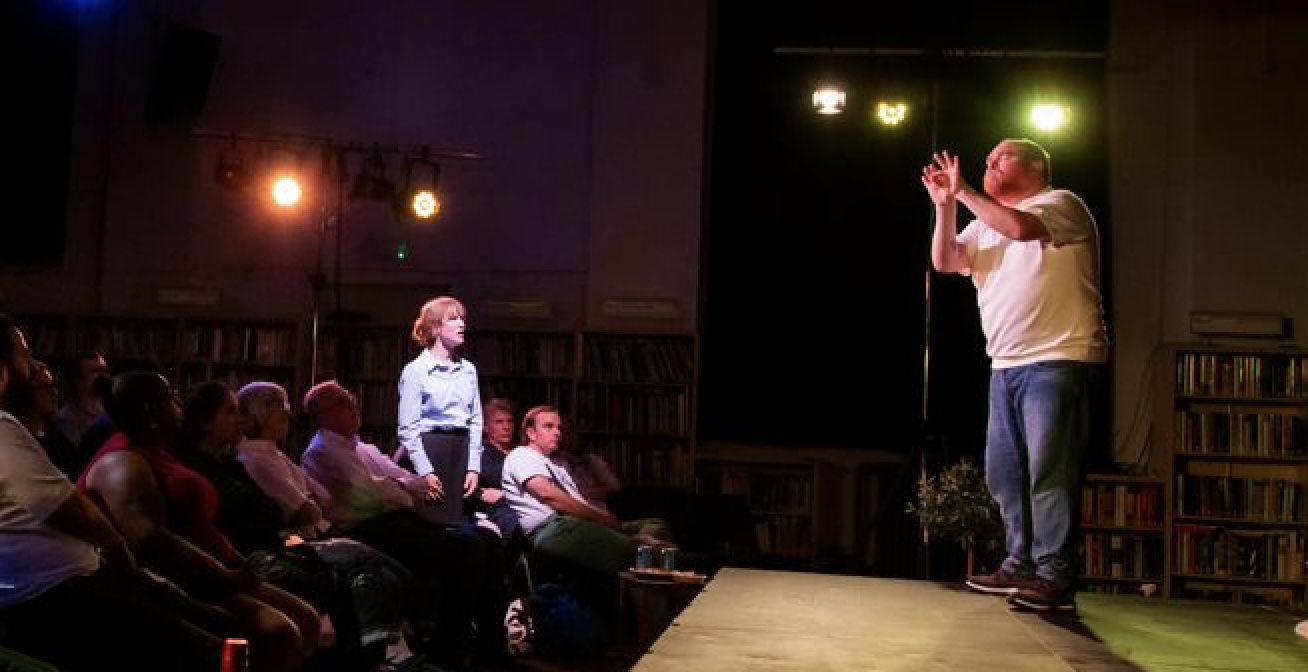
Charlotte employed an intelligent approach to staging a bilingual performance, utilising several forms of communication methods such as British Sign Language (BSL) without voice, Signed Supported English (SSE), and primarily spoken English with minimal use of sign language.
These formats were employed to reset scenarios, shift roles, and alter the storyline.
Roland, portrayed by Stephen Collins (known for his roles in films like Dune: Part One and Reunion, as well as on stage as Bob Cratchit in A Christmas Carol), is a beekeeper passionate about making honey. He describes the various types of bees and their roles in nature.
Marianne, played by Kitty Devlin (from Bridgerton), is a physicist who sees the visual poetry of the stars and space. She perceives how life aligns with the universe through her eyes and vision.
Roland and Marianne meet at a barbecue and eventually fall in love. The story is romantic but also heartbreaking, particularly when Marianne is diagnosed with a tumour in her frontal lobe.
An affair complicates their relationship, and the scenes are consistently cut short, shifting perspectives each time. These tightly interwoven scenes provide varying insights, communication methods, and power dynamics depending on who leads each scenario.
Personally, I find myself aligning with the strong BSL and deaf culture aspect of the play. For instance, I resonate with scenes such as the playful interaction about licking one’s elbow, their initial meeting at the barbecue, their trip to the ballroom, the subsequent visit to a pub, the affair, and the poetic descriptions of bees and the universe.
Each scenario deeply explores empathy and our communication and information-sharing processes.
The repetition of the timeline allowed for rephrasing and resetting; it tested the audience’s consistency in their choices. This constant change in perception reflects how we navigate our lives, choosing which doors to open or close, and encourages the audience to remain open to different perspectives and outcomes.
It is inclusive, but it is also a choice of what is accessible to an individual in the audience because the audience had an open range from deaf BSL users to hearing non-signers.
The repetitiveness kept me guessing what to expect in each scene. I wondered who would hold the power, who would suffer the most, who would achieve their desires, and how they would navigate their lives together.
I was particularly intrigued by the use of various languages illustrated in each scene. Although it was dynamic, the creative captions didn’t specify the forms of communication being used—be it BSL, SSE, or spoken English.
However, when BSL was employed in a poetic or visual manner, the captions featured imagery that established a beautiful connection, highlighting elements like hive placements, bee displays, and concepts from cosmology, quantum mechanics, and string theory.
I felt a strong connection to the monologues and visual storytelling of Roland and Marianne related to their specific interests.
One particularly comedic moment involved Roland humorously describing bee mating, extending into the nuances of Deaf culture and the queen bee’s mating process—it was genuinely hilarious!
I sensed a hint of Stephen Hawking in Marianne’s character, who, despite her intelligence about stars, space, and the universe, faced the reality of her body failing her. The scene often reset to the lounge where Marianne spoke about her childhood, struggling to find words, losing confidence, and questioning her beliefs about God.
The universe is both a miracle and a mystery, reflecting the same complexities we face in our own bodies.
I want to applaud the actors for their remarkable ability to remember each scene, navigate the shifting scenarios, and deliver phenomenal performances.
As I read the programme, I recognised the beauty of the collective effort that brought Constellation to life. Charlotte contributed immense enthusiasm and dedication to creating this unique performance.
It is a thought-provoking show that presents various outcomes and allows the audience to reflect on their own life choices. This was a significant commission by Hear Art, providing Charlotte Arrowsmith with the space to explore language, communication, and relationships.
Photography credit: Rob Greig
Press tickets were offered in exchange for an honest review. To enquire about further reviews by Mary-Jayne please contact her at maryjayne@mail.com
Enjoying our eggs? Support The Limping Chicken:

The Limping Chicken is the world's most popular Deaf blog, and is edited by Deaf writer and photographer Charlie Swinbourne.
Our posts represent the opinions of blog authors, they do not represent the site's views or those of the site's editor. Posting a blog does not imply agreement with a blog's content. Read our disclaimer here and read our privacy policy here.
Find out how to write for us by clicking here, and how to follow us by clicking here.
This site exists thanks to our supporters. Check them out below:
- Lumo TV: TV programmes in BSL for the Deaf community
- Bellman & Symfon: home alerting solutions, including the mobile phone transceiver!
- SignVideo: Instant BSL video interpreting online
- British Deaf Association: Working to transform the way BSL is accessed in the UK
- 999 BSL: call 999 in an emergency, in BSL
- Deaf Umbrella: Making colleges and workplaces more accessible
- Appa: Looking for RSLIs, TSLIs and CSWs, apply here!
- Signly: Adding BSL to websites
- Signworld: Learn BSL online!
- DCAL: world-class research into deafness, cognition and language
- Lipspeaker UK: specialist lipspeaking support
- BID: Deaf services, including advice and support, interpreting, employment and letters
- Interpreting Matters: BSL interpreting agency
- Sign Solutions: Instant access to Interpreters, training and BSL translation nationwide
- InterpretersLive: On demand BSL video interpretation
- Performance Interpreting: BSL interpreting at concerts
- National Deaf Children's Society: The leading charity for deaf children
- Action Deafness: “A Deaf-Led Charity” – interpreting & community support services




Posted on September 28, 2026 by Rebecca A Withey
0