
Hearing people, eh? You can’t live with them, you can’t live without them.
Statistics show that five in six people are hearing. That’s a whopping 50 million people in the UK, and nearly 6 billion people worldwide. They’re literally everywhere.
Of course, the term ‘hearing people’ only really exists in the deaf world, because hearing folk generally see themselves as being, simply, ‘people.’
But to us Deafies, they’re fundamentally different to us. And we know there are certain things only hearing people do.
So, listed for convenience, here are the 10 things I’d rather hearing people did a whole lot less – their very most annoying habits.
Apologies in advance for the low-fi sketches – I got a bit carried away.
1. Overhearing things they aren’t even listening to

Whether there’s an office meeting, a social gathering or a major news event, you can bet your bottom dollar that the last person to find out will be… the deaf employee.
“But everyone knew about our party!” their colleague will later say, forgetting how he found out – when he overheard the boss talking to the secretary while he was walking past to get a cup of tea.
Hearing people listen when they’re not even trying to. They even learn things from the information they overhear. This phenomenon even has a term: incidental learning.
Learning without even meaning to? That’s just ANNOYING.
2. Correcting our pronunciation

To hearing people, it seems crazy that a grown man, 42 years of age, perhaps even the Editor of this site, could pronounce a basic word incorrectly.
When this happens, they tend to either burst out laughing (as Callum Fox wrote about here) or correct us (as I wrote about in this article).
Forgetting, of course, that since we don’t hear so well, we may not have heard quite how a word should sound.
It’s embarrassing, but we can’t help it.
So it’s not really funny. Don’t ridicule us. Don’t correct us. Let it slide.
We did the speech therapy. It helped, but clearly, it had its limits.
Focus on what we were trying to say, not exactly how we said it. Then we can all move on.
3. Being too subtle

If a deaf person thinks I’ve put on weight, they tell me. There’s no place to hide with sign language. They point at me, puff out their cheeks, then their hands track a big round shape to visually describe my belly.
The message is pretty clear. I may have over-indulged just a bit lately.
What about a hearing person? They look me up and down, do a few mental calculations, and then say the opposite of what they’re really thinking: “You’re looking well.”
Looking well? What they mean is, “You’ve put on a few pounds mate.” You know it, and they know it.
So why can’t they say it?
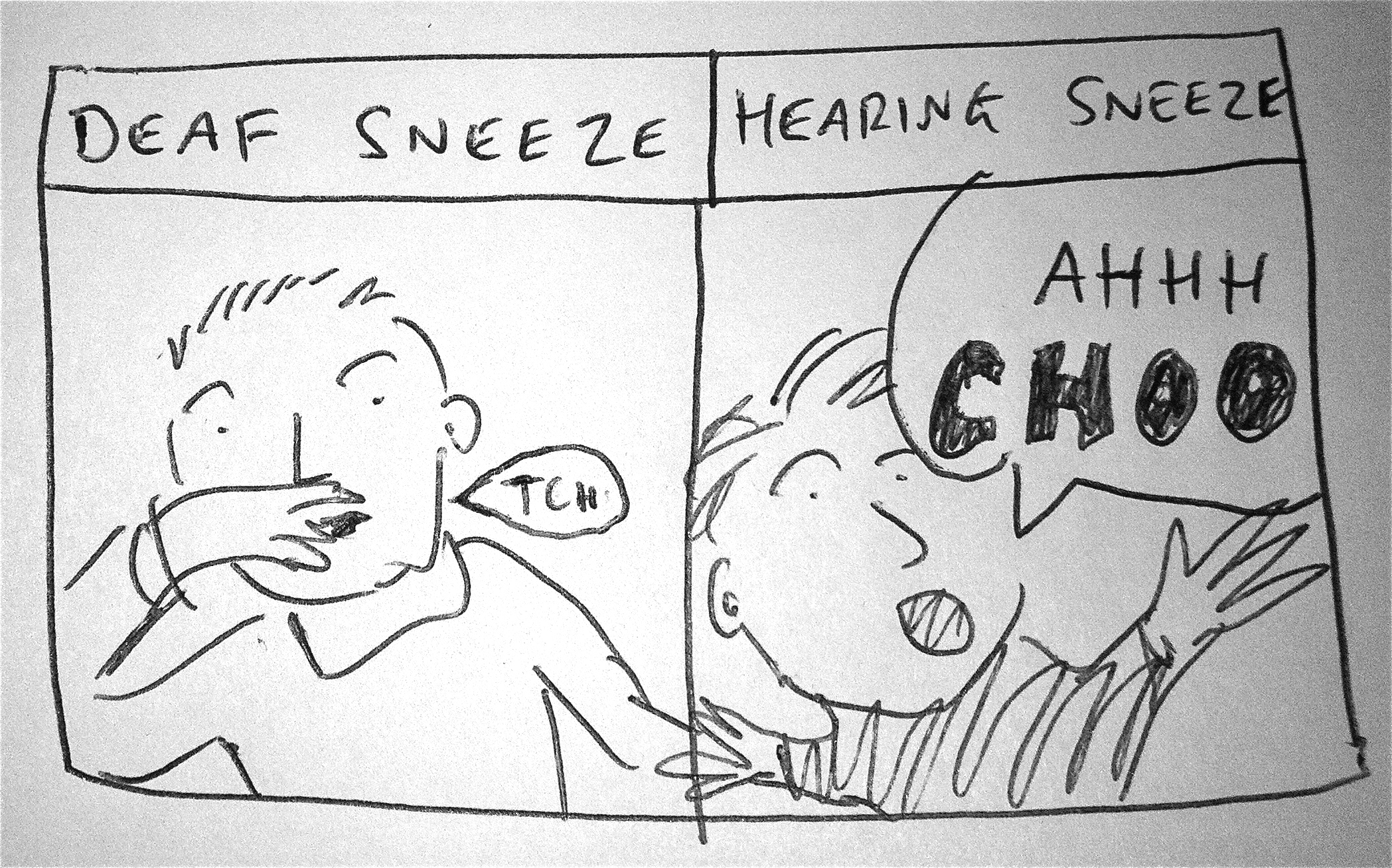
4. Faking sneezes

Perhaps the biggest hearing deception of all.
While deaf people sneeze naturally, hearing people feel compelled to moderate their output and add SFX, in the form of that “ah-choo” noise.
All so they can be more socially acceptable.
Stop thinking you’re a better person because you ‘ah-choo,’ my hearing friend.
Sneeze organically. Sneeze fairtrade.
Sneeze as God intended. Like deaf people do.
5. Looking away while communicating

Hearing people look everywhere when you talk to them.
They scan the room for other people who might have arrived. They glance at their phone in case they have a new message. Or they just stare at the blank wall behind you.
For deaf people it’s distracting, irritating, borderline offensive.
One hearing person realised this. Out of nearly 6 billion hearing people, one of them saw things differently, and perceived an advantage to the way deaf people maintain eye contact.
We salute you, Bruno Kahne.
Kahne said in this Limping Chicken interview that hearing people could learn a lot from the way deaf people communicate, because deaf people give you their full attention.
He went on to run training courses in communicating the deaf way, and later wrote a book.
He’s dead right. Because we lipread, we have to focus hard on people’s lips (sorry if this makes you uncomfortable. by the way).
Because we’re trying to figure out what you’re saying, we can’t switch off.
Because we’re deaf, we’re forced to really LISTEN.
We give you our full attention.
Why not give us yours?
6. When you go a bit deaf, pretending you don’t need hearing aids

This one’s not aimed at hearing people per se, but rather, those who act like they’re still hearing, despite having become a bit deaf.
What are they so ashamed of?
Rather than tell people that they don’t understand things from time to time, they pretend they’re not deaf at all. They live in denial.
Soon, their families become frustrated with them for not understanding anything, their neighbours wonder why the television has to be on so loudly all the time, and often, they retreat into a world of their own.
Rather than wear hearing aids and admit they’re a bit deaf, maybe taking a BSL course or lipreading class, they’d rather be thought of as a bit wacky and random. They’d rather be left out. It’s funny in a way, except it’s also very, very sad.
What’s so bad about being thought of as being deaf, that you’d have to hide it?
Beats us.
7. Singing in tune

Ok, so we don’t want hearing people to deliberately start singing out of tune, that wouldn’t be good for us, you, us, or anybody (although it’d be a lot of fun if it happened, en-masse, during an episode of The Voice).
We’d just like you to be a little less smug about being able to sing in tune.
When a deaf person sings along to a song, just for the fun of it, because we love the tune, or we’re in the moment – leave us be.
Don’t tell us how bad we sound.
Don’t act like we shouldn’t even open our mouths in future for fear of offending your precious hearing ears.
Don’t – whatever you do – proceed to then sing it with perfect pitch, to show us how it should be done.
We’re deaf. We wear hearing aids. NHS hearing aids. With waxy molds.
We’ve got passion by the bucket-load, but we’re never going to be good singers.
Accept it. Cover your ears.
Let us have our moment.
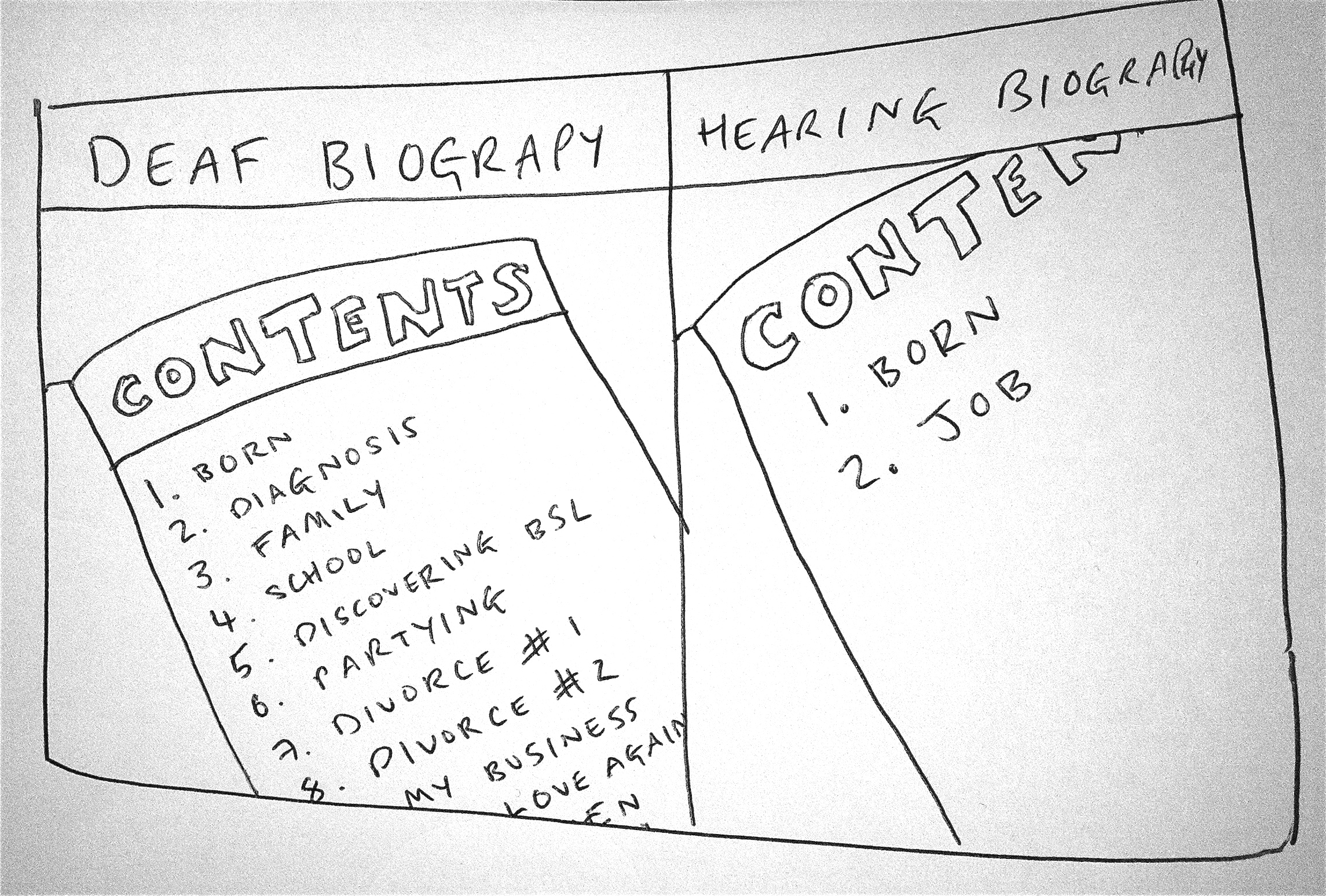
8. Not telling us your life story

When you meet a deaf person for the first time, they cut to the chase: you’re given immediate access to their life story.
Things like the exact genetic reason for their deafness. Their family history. Their school. A gritty breakdown of their last two divorces. The state of their current relationship, for good measure. The delicate condition that meant they had to have a hospital appointment last week.
All this in roughly the first half hour.
On the other hand, when meeting hearing people, you just find out where they grew up and what job they do. The rest? It takes a lifetime to find out.
Really knowing a hearing person takes real commitment, not only to years of friendship, but also years of piecing the thinnest snippets of information together, all while lipreading what they’re saying.
Just tell us, dear hearing friends – why was your mother in law imprisoned in Cambodia on that family holiday?
We need to know.
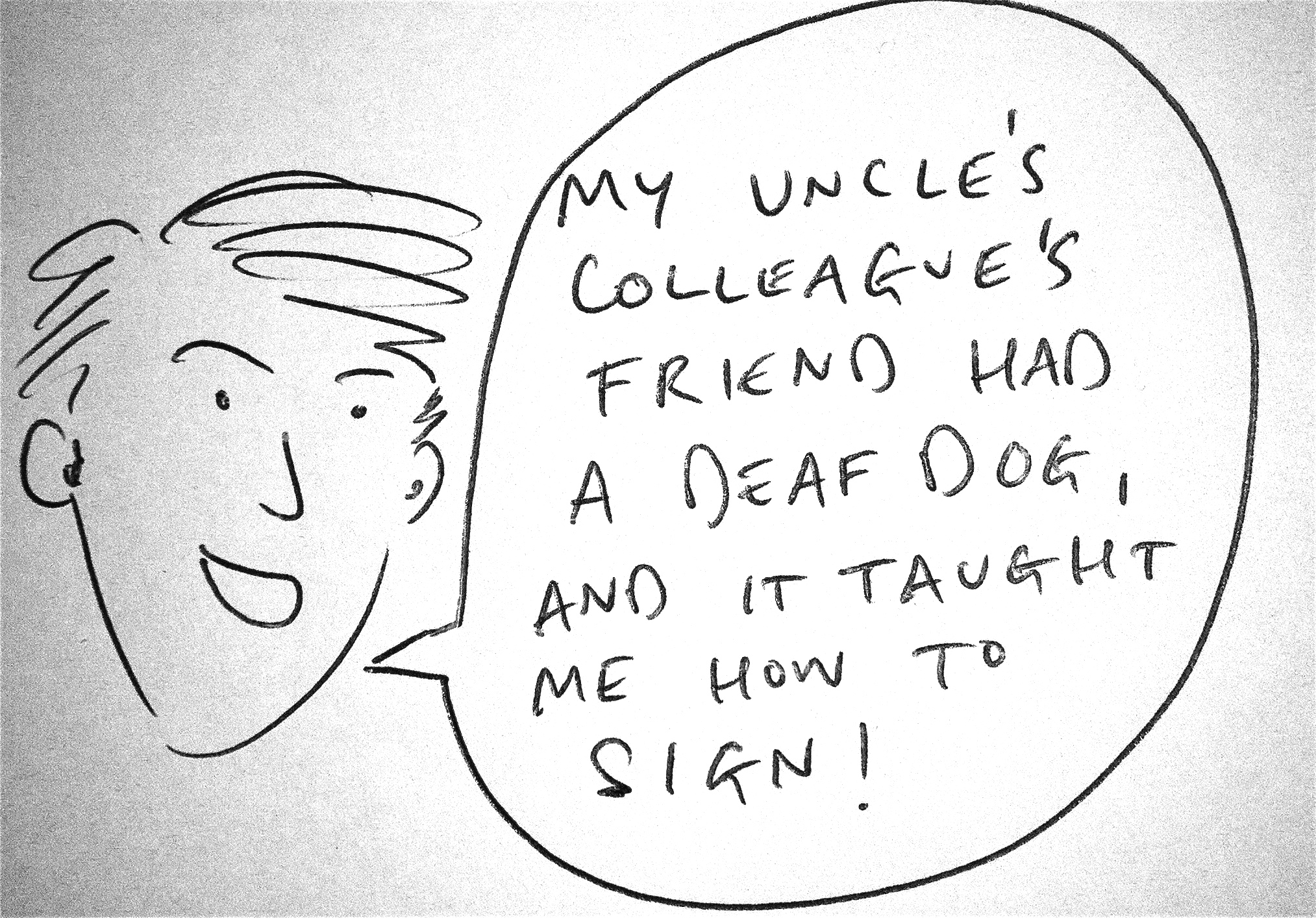
9. Assuming

That because your auntie’s cousin’s step-father’s love child’s dog was deaf, you’re an expert in deafness.
Don’t assume…
That all deaf people are the same.
Some use sign language, and some lipread. Some like to use a sign language interpreter, others prefer speech-to-text.
Some swing in different ways on the above, but don’t assume it’s ok to call us ‘swingers’ as a result.
Don’t assume… that because we understood everything you said one day, we’ll hear everything you say the next.
We might be in a noisy place. You might speak less clearly. We might be tired, from, y’know, lipreading you all day yesterday.
Don’t assume… you’re cleverer than us because we occasionally mishear something.
You won’t know how clever we are from how quickly we make sense of something you say. A fairer way of judging it would be a game of chess, or a quiz, or an IQ test for that matter.
Basically… don’t assume. Or we’ll assume things about you, too.
Like… you’re not very nice.
Or something along those lines.
10. Shouting at us

I’m finding it hard to understand you, my hearing acquaintance, so why not speak a little more clearly?
Stop mumbling and covering your mouth, or looking around the room.
Look at me, speak clearly, rephrase what you’re saying, maybe slow down just a little bit.
Whatever you do, don’t start SHOUTING at me.
Please.
It’s embarrassing.
It doesn’t help me to understand you.
And it makes me feel a bit scared.
Have you noticed any annoying hearing habits not listed above? Tell us below!
DISCLAIMER: This site apologises to deaf-aware hearing people who are guilty of none of the above, and also acknowledges that not all of you are like this. Just some of you. Quite a lot of you.
By Charlie Swinbourne, writer, director, journalist and Editor of this site.
NOTE: This is an updated version of this article, with BSL translation (thanks to Signly) and new illustrations.
Enjoying our eggs? Support The Limping Chicken:

The Limping Chicken is the world's most popular Deaf blog, and is edited by Deaf writer and photographer Charlie Swinbourne.
Our posts represent the opinions of blog authors, they do not represent the site's views or those of the site's editor. Posting a blog does not imply agreement with a blog's content. Read our disclaimer here and read our privacy policy here.
Find out how to write for us by clicking here, and how to follow us by clicking here.
This site exists thanks to our supporters. Check them out below:
- Lumo TV: TV programmes in BSL for the Deaf community
- Bellman & Symfon: home alerting solutions, including the mobile phone transceiver!
- SignVideo: Instant BSL video interpreting online
- British Deaf Association: Working to transform the way BSL is accessed in the UK
- 999 BSL: call 999 in an emergency, in BSL
- Deaf Umbrella: Making colleges and workplaces more accessible
- Appa: Looking for RSLIs, TSLIs and CSWs, apply here!
- Signly: Adding BSL to websites
- Signworld: Learn BSL online!
- DCAL: world-class research into deafness, cognition and language
- Lipspeaker UK: specialist lipspeaking support
- BID: Deaf services, including advice and support, interpreting, employment and letters
- Interpreting Matters: BSL interpreting agency
- Sign Solutions: Instant access to Interpreters, training and BSL translation nationwide
- InterpretersLive: On demand BSL video interpretation
- Performance Interpreting: BSL interpreting at concerts
- National Deaf Children's Society: The leading charity for deaf children
- Action Deafness: “A Deaf-Led Charity” – interpreting & community support services




Melanie Gadsdon
May 16, 2025
Charlie, you are so typically deaf in manners and in behaviour as you wrote about 10 Annoying habits that hearing people do. Well I have plenty of answers to your comments. Hearing people behave like they always do. Why should we expect hearing people to respond to “us deafies” just because they do not understand what it is like to be in a “deaf world”. Why do many Welsh people insist on only speaking Welsh (because they want to be segregated), Cornish people now insist on speaking “Kernow” because they want to be identified as Cornish. Nowadays I hear many people in the UK speaking different languages because they are from other countries, why are they not speaking in English? Tower of Babel! People in wheelchairs want other people to empathise with them, people who are “old” don’t want younger people to talk over them (I should know!) Musically, what about Evelyn Glennie (who is famously deaf) plays music in an orchestra! Many people want to retain their identity. I have said this for many years that there is a “Deaf world” and a “Hearing world” and “Never the Twain should they meet”.