
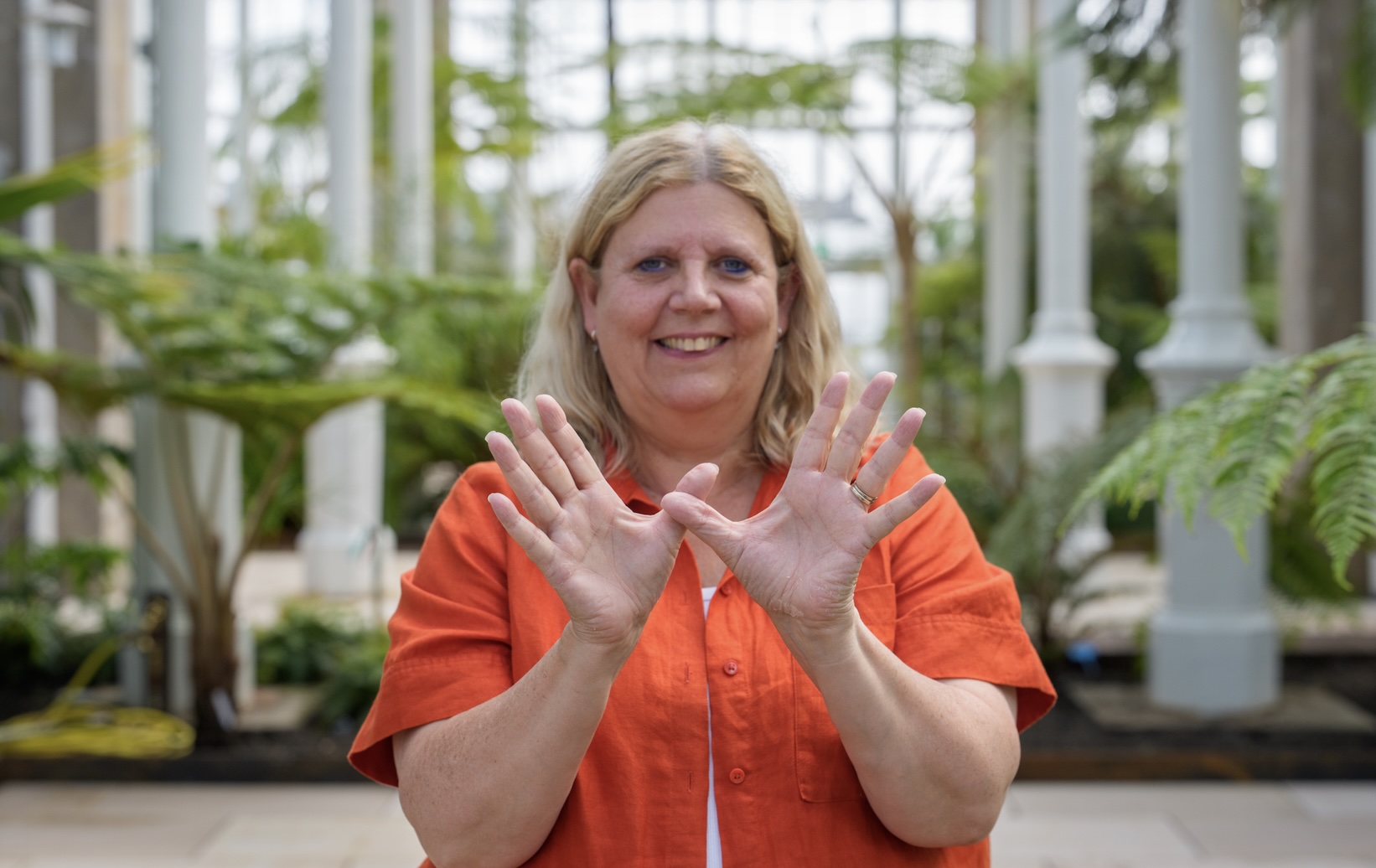
The Royal Botanic Garden Edinburgh (RBGE) will become the first botanic garden in the UK to introduce British Sign Language (BSL) films featuring newly developed botanical signs when its restored Palm Houses reopen this autumn.
The project, developed in partnership with the Scottish Sensory Centre at the University of Edinburgh, aims to improve access for Deaf visitors by introducing new botanical vocabulary in BSL and sharing stories about plants found within the Garden’s Living Collection.
Thirteen botanical concepts have been developed into new BSL signs for the project, including palm, fern, tree fern, frond, spore, epiphyte, climbing plant, tendril, leaflet, rhododendron, conifer and cactus.

Visitors will be able to watch a series of short BSL films by scanning QR codes throughout the restored 19th-century Palm Houses using the Bloomberg Connects app.
Sarah Cathcart, Director of Learning and Engagement at RBGE, said the project had been created to provide a more meaningful experience for Deaf visitors.
“Working closely with the Scottish Sensory Centre’s BSL Glossary team, we have developed a set of elegant and expressive new signs in British Sign Language to deliver a more meaningful and immersive experience for members of the Deaf community visiting the Garden.
These signs represent just the beginning of this important project. Through this collaboration we will continue to expand botanical vocabulary, ensuring that the natural world is more inclusive and accessible for all.”
The new signs were developed through collaboration between RBGE scientists, horticulturists and the Scottish Sensory Centre’s BSL Glossary project, led by Dr Audrey Cameron. Together, they identified the defining characteristics of different plants and botanical features before a Deaf-led team of BSL scriptwriters and signers created signs to represent each concept.
Dr Cameron said the project helps address a longstanding lack of botanical vocabulary in BSL.
“At present, very few botanical terms exist in BSL – even for familiar plant species such as daffodils. By creating new language designed specifically for the Deaf community, this unique project takes an important step forward in widening access to the wonders of plant biodiversity.”
As well as being used in the Palm Houses, the new botanical signs will be shared with organisations across the UK to encourage wider use and improve access to botanical knowledge for BSL users.
The films form part of the wider restoration of the Garden’s historic Palm Houses, which reopen this autumn following a major conservation project funded by the National Lottery Heritage Fund and the Scottish Government.
The Scottish Sensory Centre’s BSL Glossary project has previously developed more than 4,500 STEM signs in collaboration with Deaf scientists, educators and BSL linguists, helping to expand specialist vocabulary across science and education.
To find out more about the Palm Houses and plan a visit, see the Royal Botanic Garden Edinburgh’s Palm Houses webpage
Enjoying our eggs? Support The Limping Chicken:

The Limping Chicken is the world's most popular Deaf blog, and is edited by Deaf writer and photographer Charlie Swinbourne.
Our posts represent the opinions of blog authors, they do not represent the site's views or those of the site's editor. Posting a blog does not imply agreement with a blog's content. Read our disclaimer here and read our privacy policy here.
Find out how to write for us by clicking here, and how to follow us by clicking here.
This site exists thanks to our supporters. Check them out below:
- Lumo TV: TV programmes in BSL for the Deaf community
- Bellman & Symfon: home alerting solutions, including the mobile phone transceiver!
- SignVideo: Instant BSL video interpreting online
- British Deaf Association: Working to transform the way BSL is accessed in the UK
- 999 BSL: call 999 in an emergency, in BSL
- Deaf Umbrella: Making colleges and workplaces more accessible
- Appa: Looking for RSLIs, TSLIs and CSWs, apply here!
- Signly: Adding BSL to websites
- Signworld: Learn BSL online!
- DCAL: world-class research into deafness, cognition and language
- Lipspeaker UK: specialist lipspeaking support
- BID: Deaf services, including advice and support, interpreting, employment and letters
- Interpreting Matters: BSL interpreting agency
- Sign Solutions: Instant access to Interpreters, training and BSL translation nationwide
- InterpretersLive: On demand BSL video interpretation
- Performance Interpreting: BSL interpreting at concerts
- National Deaf Children's Society: The leading charity for deaf children
- Action Deafness: “A Deaf-Led Charity” – interpreting & community support services




Posted on August 6, 2026 by Rebecca A Withey