
Hi, I’m Mira Podorský, founder and product designer of Captitles — software designed to make theatre captioning easier.
I’ve always been interested in theatre. I studied New Media at the Faculty of Arts and Design and have worked on theatre projects myself, including creating music and digital scenography.
Through this work, I became interested in how technology could make theatre more accessible without making the process complicated for the people producing it.
Captioning is one area where I think there is room to make things simpler.
For theatres, providing captions can involve preparing the text, translating it, putting it into software, operating it during the performance and finding the right technical setup.
For years, this has often meant using presentation tools that were not really designed for theatre.
I wanted to approach it differently.
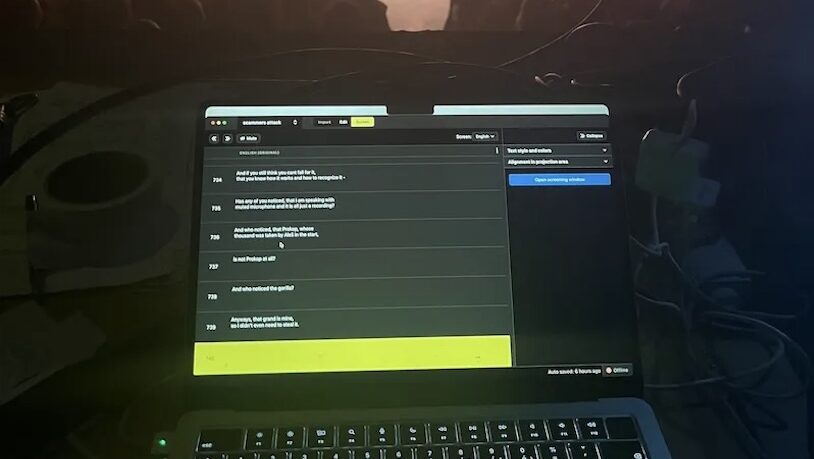
With Captitles, a theatre can start with the script it already has. The software turns the spoken dialogue into editable captions within minutes and can suggest how longer lines should be split for an audience.
The captions can then be translated using AI, or a translator, dramaturg or director can work on them directly in the same project. Preparation, translation and collaboration can all happen in one place.
The finished captions can be displayed on a projector, TV or another screen. A theatre can choose which language appears on which screen, or display several languages together.
But a theatre does not necessarily need another screen at all. Captitles can send captions directly to spectators’ phones through the mobile app. This means captions can be added without changing the stage design or installing permanent equipment.
Captitles can also send spoken versions of the captions to spectators’ phones. They can listen through headphones or compatible hearing devices, providing another way to follow a performance.
I’m interested in captioning not only as an accessibility feature, but also in what it could mean for theatres themselves.
Theatres are constantly struggling financially, and captioning is usually discussed as an accessibility cost. I think that is the wrong way to look at it.
Accessibility should also be part of the question: how do theatres reach more people?
If captioned performances become something theatres can offer regularly, rather than on one or two special dates, and audiences actually know about them, that can mean more tickets sold.
The additional audience could include people who need captions for accessibility, but also people who do not speak the local language, tourists, expats and international visitors.
A theatre does not necessarily need to attract a huge new audience for captioning to make a difference. If captions bring in one or two people who would otherwise not have bought a ticket, they may already have paid for the captioning. Every additional ticket is extra revenue.
That extra audience can make a real difference. It could help make productions possible that might otherwise stay in a drawer because experimenting with them feels out of reach, whether because of capacity or finances.
That combination is what makes the idea interesting to me: making theatre easier to access, while also making it a little easier for the people creating it to keep creating it.
Captions can be controlled manually during a performance, just as they are today. But Captitles can also connect to a microphone or audio feed, allowing the software to detect spoken dialogue and switch the corresponding captions automatically.
The idea is that theatres can start with the simplest setup and use more automation where it makes sense.
There is also a free plan, so theatres can try Captitles before making a bigger commitment. They can import a real script, prepare the captions and put them on a screen or send them to phones.
Too often, captioned theatre is offered only on one designated date, if at all.
That means a Deaf or hard-of-hearing person may have to organise their life around the theatre’s accessibility schedule, rather than simply choose the performance that suits them.
My hope is that Captitles makes captions practical enough for theatres to offer more regularly.
Captions can be shown on a shared screen, or received on a person’s own phone or tablet, so people can follow the dialogue from where they are sitting.
The aim is not to replace properly planned access or the people who make it possible, but to remove some of the practical barriers that stop theatres from offering it more often.
Captitles is available for macOS and Windows, with mobile apps for iOS and Android.
Enjoying our eggs? Support The Limping Chicken:

The Limping Chicken is the world's most popular Deaf blog, and is edited by Deaf writer and photographer Charlie Swinbourne.
Our posts represent the opinions of blog authors, they do not represent the site's views or those of the site's editor. Posting a blog does not imply agreement with a blog's content. Read our disclaimer here and read our privacy policy here.
Find out how to write for us by clicking here, and how to follow us by clicking here.
This site exists thanks to our supporters. Check them out below:
- Lumo TV: TV programmes in BSL for the Deaf community
- Bellman & Symfon: home alerting solutions, including the mobile phone transceiver!
- SignVideo: Instant BSL video interpreting online
- British Deaf Association: Working to transform the way BSL is accessed in the UK
- 999 BSL: call 999 in an emergency, in BSL
- Deaf Umbrella: Making colleges and workplaces more accessible
- Appa: Looking for RSLIs, TSLIs and CSWs, apply here!
- Signly: Adding BSL to websites
- Signworld: Learn BSL online!
- DCAL: world-class research into deafness, cognition and language
- Lipspeaker UK: specialist lipspeaking support
- BID: Deaf services, including advice and support, interpreting, employment and letters
- Interpreting Matters: BSL interpreting agency
- Sign Solutions: Instant access to Interpreters, training and BSL translation nationwide
- InterpretersLive: On demand BSL video interpretation
- Performance Interpreting: BSL interpreting at concerts
- National Deaf Children's Society: The leading charity for deaf children
- Action Deafness: “A Deaf-Led Charity” – interpreting & community support services




Posted on October 13, 2026 by Rebecca A Withey
0