
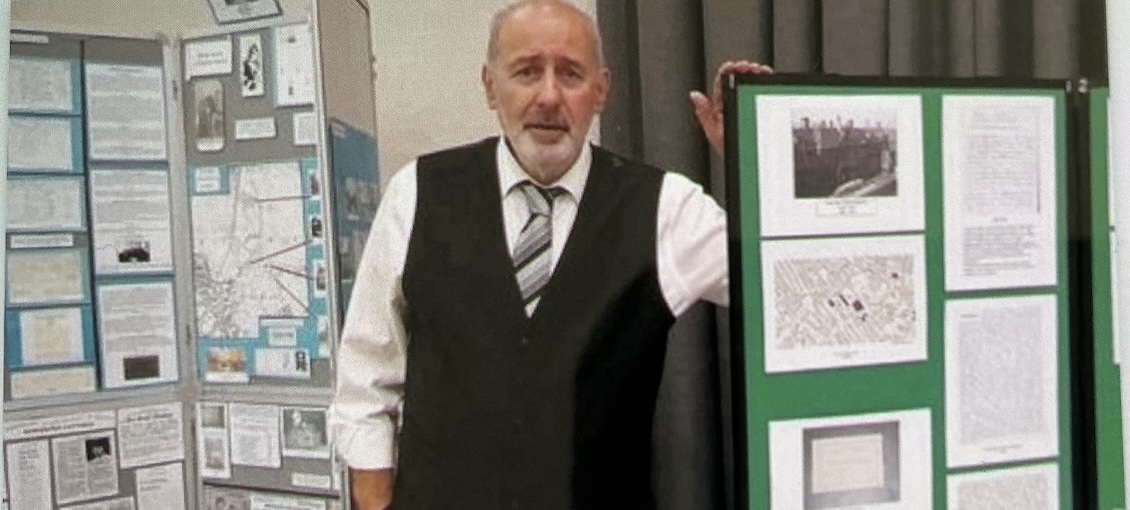
My name is Wayne Richards and I live in Wakefield. I am profoundly deaf and closely connected with the Deaf community.
I have been involved with Deaf centres, Deaf history, my Deaf colleagues and many Deaf events. I have a strong interest in Deaf history and enjoy learning about and sharing the stories of Deaf people and their community.
About 25 years ago, I started researching my family tree and Deaf history. One of my Deaf friends introduced me to Deaf history and I soon developed a real passion for it.
Over the years, I have collected information about Deaf schools, Deaf centres, Deaf workers, Deaf communities and Deaf individuals. I have also researched Deaf superintendents, road accidents involving Deaf people and many other events from Deaf history.
I enjoy discovering the connections between Deaf people. I try to find out who they married, where they lived, which Deaf school they attended and how their lives were connected to the wider Deaf community.
I have collected the names of many Deaf people from Yorkshire, and my aim is to create a Deaf family tree and connect people together. I enjoy discovering these connections and helping to preserve the history and stories of Deaf people in Yorkshire.
About 12 years ago, Joselyn and I decided to research asylums and workhouses in Yorkshire. We soon realised that Yorkshire was a very large county, so we decided to split the research into two books: one about asylums and one about workhouses.
Our first book, about Deaf people in asylums, was published in 2022 and was a sell-out. We then continued our research into Deaf people who lived in workhouses.
Yorkshire’s Abandoned Few is about Deaf people in Yorkshire who lived in workhouses for many different reasons.
Some were abandoned by their families, some lost their parents and others were orphans. Many came from families living in poverty, while others were unemployed and had no benefits or pensions.

Some were tramps or vagrants, unmarried mothers or people who were mentally ill.
There are 84 individual stories of Deaf men and women who lived in the past. Some are sad and some are heartbreaking.
The research shows that the names of Deaf people can be found in census records, but very little was written about their lives, experiences and communities.
Deaf people were often forgotten or ignored by wider society. Hearing people did not always know about, understand or want to learn about the lives of Deaf people.
Life was hard for Deaf people experiencing hardship. They could have difficulty communicating with authorities, guardians, doctors or fellow inmates.
Deaf paupers were vulnerable to misunderstanding, neglect and mistrust.
Workhouses were meant to protect some of the most vulnerable people by providing them with a safe and secure environment, but they could also become places of hardship and tragedy.
A handful of Deaf people were residents for more than 50 years through no fault of their own.
It was important to us to bring these stories to light and give these forgotten Deaf people a place in Yorkshire’s history. It is very important that we put their names to faces, otherwise they would be lost to history.
Researching these books has involved a lot of hard work, research and travelling to different places to find information. Joselyn and I keep in touch by text message and FaceTime, and we visit each other’s homes.
We work together to organise the stories and turn our research into written chapters for the books.
We get information and support from libraries, archives, Ancestry, Findmypast and Deaf magazines. We also spend a lot of time checking the information, arranging the layout and proofreading the books with the help of Deaf friends before they are finished.
When both books were finished, I was very pleased and inspired by what we had achieved. It was a long journey, but I am proud of the two books and the stories we discovered.
I hope Deaf people will continue to do research and make books about other counties and areas, such as Lancashire, Scotland, Wales and London. It would be good to include information about workhouses, asylums and the lives of Deaf people in the past.
I am now planning to write a new book about Deaf people in Lincolnshire workhouses and asylums with Jane Foulston. I hope we can continue to discover and preserve the stories of Deaf people from the past.
I recommend these books to Deaf people, friends and colleagues who are interested in Deaf history. I also think hearing people who have studied Deaf people and Deaf history at university may enjoy them.
The books may be useful for anyone who wants to learn more about the lives, experiences and history of Deaf people.
Yorkshire’s Abandoned Few costs £25 including postage and packaging. If you are interested in buying a copy, please contact Wayne Richards or Joselyn Taylor for more information on:
joselyn@btopenworld.com or w.c.richards@hotmail.co.uk
Please also feel free to share this with anyone who may be interested.
Enjoying our eggs? Support The Limping Chicken:

The Limping Chicken is the world's most popular Deaf blog, and is edited by Deaf writer and photographer Charlie Swinbourne.
Our posts represent the opinions of blog authors, they do not represent the site's views or those of the site's editor. Posting a blog does not imply agreement with a blog's content. Read our disclaimer here and read our privacy policy here.
Find out how to write for us by clicking here, and how to follow us by clicking here.
This site exists thanks to our supporters. Check them out below:
- Lumo TV: TV programmes in BSL for the Deaf community
- Bellman & Symfon: home alerting solutions, including the mobile phone transceiver!
- SignVideo: Instant BSL video interpreting online
- British Deaf Association: Working to transform the way BSL is accessed in the UK
- 999 BSL: call 999 in an emergency, in BSL
- Deaf Umbrella: Making colleges and workplaces more accessible
- Appa: Looking for RSLIs, TSLIs and CSWs, apply here!
- Signly: Adding BSL to websites
- Signworld: Learn BSL online!
- DCAL: world-class research into deafness, cognition and language
- Lipspeaker UK: specialist lipspeaking support
- BID: Deaf services, including advice and support, interpreting, employment and letters
- Interpreting Matters: BSL interpreting agency
- Sign Solutions: Instant access to Interpreters, training and BSL translation nationwide
- InterpretersLive: On demand BSL video interpretation
- Performance Interpreting: BSL interpreting at concerts
- National Deaf Children's Society: The leading charity for deaf children
- Action Deafness: “A Deaf-Led Charity” – interpreting & community support services




Posted on October 23, 2026 by Rebecca A Withey
0