
I’m Ben Glover, a Deaf video designer and creative captioner based in London. My work takes me all over the country and even internationally. I’m particularly drawn to the intersection of accessibility and creativity, exploring how we can reframe access and integrate it from the outset of a creative process.
Captions are considered long before rehearsals even begin, collaborating with creatives like the set designer, director and lighting designer. This allows us to think about how captions can be seamlessly integrated into a show.
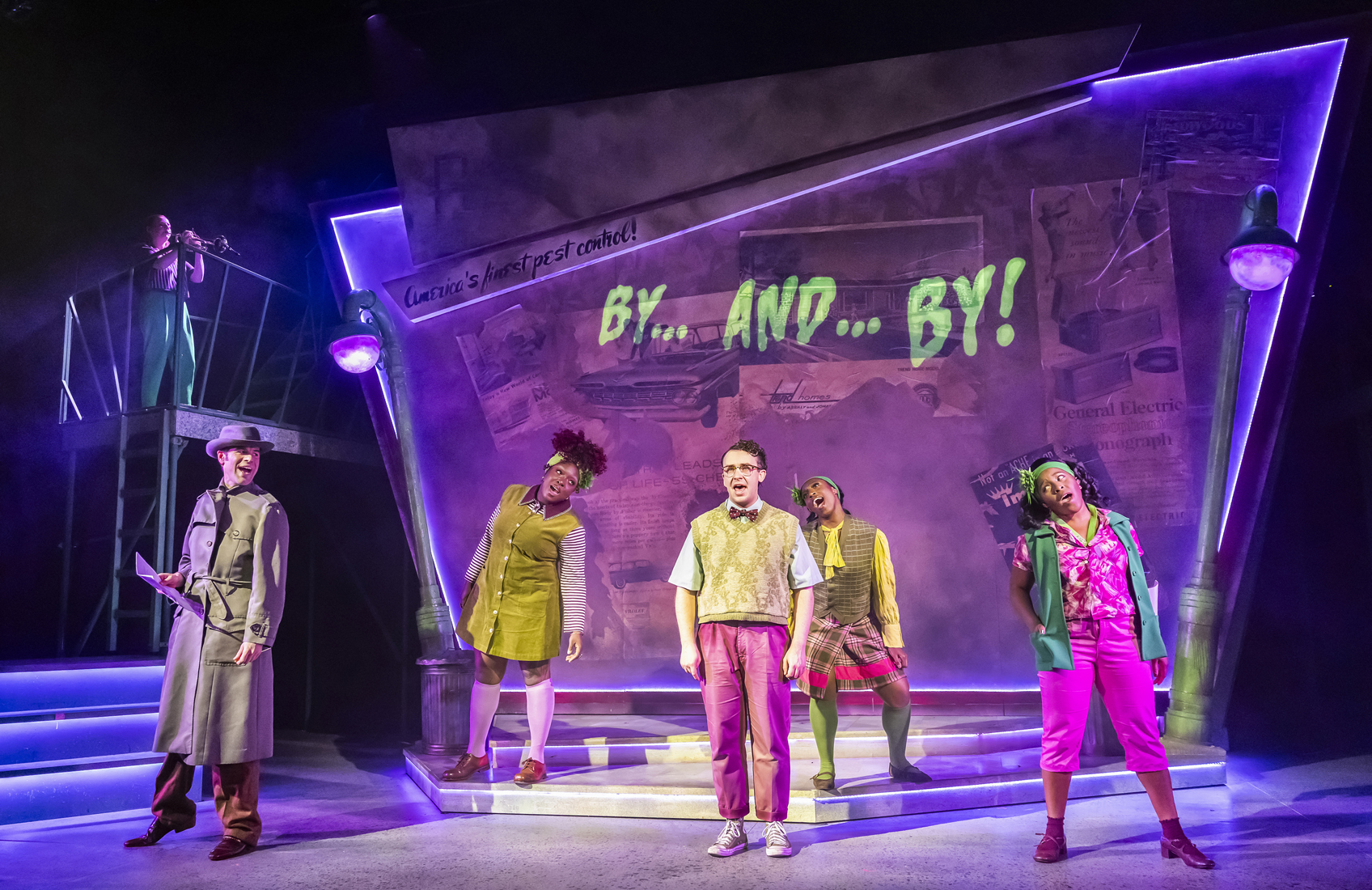
As a result, captions are thoughtfully placed within the set and even become part of the design, using fonts, colours and animations that match the story’s tone.
I first discovered creative captioning through Graeae and Definitely Theatre over a decade ago. It truly inspired me to explore ways to incorporate it into my own work.
I’ve been fortunate enough to collaborate with both companies since then, with many more shows to come. While it’s still a relatively new creative practice, I’m constantly learning on the job. Each show presents unique challenges, pushing me to think of different approaches to text.
“Little Shop of Horrors” is the perfect canvas for exploring creative captioning, given its dark comic style. I’ve been inspired by comic book graphics and vintage B-movie posters with a slightly ominous twist.

Imagine text that wiggles menacingly in Audrey II-like plant textures and red flourishes!
Earlier this year, we started conversations with Sarah (director) and Verity (set and costume designer) to discuss our inspirations and an overall colour theme for the show.
I worked closely with Verity to ensure we had excellent surfaces for projecting captions, keeping them close to the action on stage and ensuring they’re always visible and accessible throughout the performance.
Before rehearsals, we spend a lot of time planning the technical aspects. This is crucial, ensuring we have the right equipment, calculating font sizes and editing the script. Once everything’s sorted, I can begin designing the captions.
Working alongside rehearsals helps me check timings and actor blocking. All this lives on my computer, so I can only share ideas through short videos or images.
It’s only during technical rehearsals with the full set and equipment that we can finally see it at scale. Then the captions truly come alive, becoming part of the world alongside the lighting design.

Creating captions for a fast-paced show like Little Shop of Horrors is a challenge. The dialogue is fast-paced and the musical moments overlap. To overcome this, I’ve used stacked captions, giving audiences more time to read them rather than a flashcard style.
I’ve also incorporated backing vocals that appear slightly fainter than the main vocals, mirroring how they’re sung.
The response from audiences for creative captions in general has been fantastic and incredibly positive. They’ve not only appreciated the captions creatively but also realised their usefulness, especially during loud or difficult moments. In musicals some have even said they help them sing along!
My favourite part of the show is during “The Meek Shall Inherit”. It’s a moment where all the caption styles come together, and the comic book inspiration truly shines. I won’t spoil too much, so make sure to come and see the show!
Finally, I hope Deaf audiences discover how captioning not only makes the work accessible but also supports the cast of Little Shop of Horrors by demonstrating tone and character quality through the animations and text styles.
Little Shop of Horrors is running at Derby Theatre until Saturday 20th June 2026. For more information see here.
Photography credit: Pamela Raith
Enjoying our eggs? Support The Limping Chicken:

The Limping Chicken is the world's most popular Deaf blog, and is edited by Deaf writer and photographer Charlie Swinbourne.
Our posts represent the opinions of blog authors, they do not represent the site's views or those of the site's editor. Posting a blog does not imply agreement with a blog's content. Read our disclaimer here and read our privacy policy here.
Find out how to write for us by clicking here, and how to follow us by clicking here.
This site exists thanks to our supporters. Check them out below:
- Lumo TV: TV programmes in BSL for the Deaf community
- Bellman & Symfon: home alerting solutions, including the mobile phone transceiver!
- SignVideo: Instant BSL video interpreting online
- British Deaf Association: Working to transform the way BSL is accessed in the UK
- 999 BSL: call 999 in an emergency, in BSL
- Deaf Umbrella: Making colleges and workplaces more accessible
- Appa: Looking for RSLIs, TSLIs and CSWs, apply here!
- Signly: Adding BSL to websites
- Signworld: Learn BSL online!
- DCAL: world-class research into deafness, cognition and language
- Lipspeaker UK: specialist lipspeaking support
- BID: Deaf services, including advice and support, interpreting, employment and letters
- Interpreting Matters: BSL interpreting agency
- Sign Solutions: Instant access to Interpreters, training and BSL translation nationwide
- InterpretersLive: On demand BSL video interpretation
- Performance Interpreting: BSL interpreting at concerts
- National Deaf Children's Society: The leading charity for deaf children
- Action Deafness: “A Deaf-Led Charity” – interpreting & community support services




Chris
June 6, 2026
But what happens if an actor misses some lines out?