
As a deaf theatre-goer, there are some shows that have always existed on the edge of my understanding.
Little Shop of Horrors was one of them.
I vaguely remembered seeing the 1986 film as a child, but without captions I never fully understood the plot or the lyrics. What stayed with me were the visuals: the giant plant, Audrey II; the quirky flower shop; the comic-book colours; and the wonderfully larger-than-life characters, especially the Dentist.
So when I discovered that Derby Theatre’s production of Little Shop of Horrors, co-produced with Northern Stage and directed by Sarah Brigham, featured creative captions on every performance, I was genuinely excited.
From the moment the show began, I knew I was in safe hands.
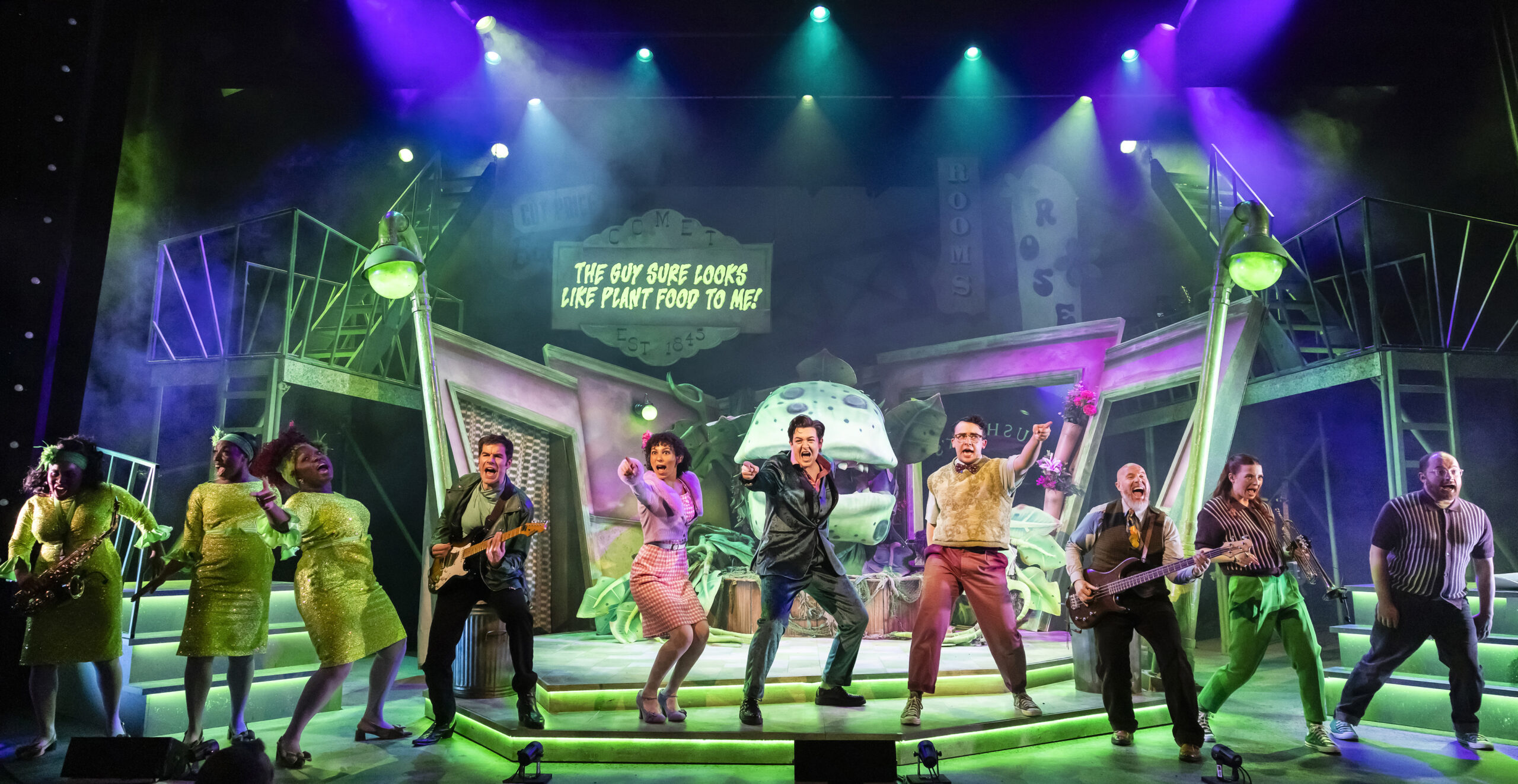
Created by Ben Glover, the captions were thoughtful, imaginative and beautifully integrated into the production. Dialogue appeared in clear, easy-to-read blocks of text. Song lyrics were larger, often animated and colour-coded.
Sound effects appeared and disappeared across the stage; bells rang visually, words drifted through the space and captions faded in and out as naturally as the action unfolding around them.
The captions appeared in a variety of forms too. Sometimes they floated above characters’ heads in speech bubbles. Sometimes they appeared as blocks of text or single words moving across the stage. Rather than feeling bolted on as an accessibility feature, they felt like part of the artistic design itself.
Most importantly, for the first time in my life, I fully understood the story.
The show follows Seymour, a shy and awkward plant enthusiast who discovers a mysterious alien-like plant. Unfortunately, he soon realises the plant thrives on human blood. Along the way we meet Mr Mushnik, the flower shop owner, Audrey – Seymour’s long-time crush – and Audrey’s abusive boyfriend, the sadistic dentist Orin.
The plot is completely bonkers, if I’m honest, but that’s exactly why people love it. It’s gloriously silly, wonderfully theatrical and never takes itself too seriously.
One of the highlights for me was “I Am Your Dentist”. I’d completely forgotten about Steve Martin’s iconic performance in the film version, so seeing this number on stage caught me by surprise. It made me laugh out loud with delight.
The audience clearly felt the same. Throughout the evening I could see shoulders shaking with laughter, particularly whenever Audrey Two spoke. The trio of street urchins – Crystal, Ronette and Chiffon – acted almost like narrators, weaving through the story with singing, dancing and musical commentary, adding even more energy and humour to the production.
The casting throughout was sublime.
Kristian Cunningham was perfect as Seymour. At least, visually speaking for my deaf ears, everything about his performance felt considered. From the way he stood to the nervous fiddling with his jumper and his awkward attempts to placate the increasingly demanding Audrey II, he embodied Seymour’s anxious charm completely.
The musical numbers were equally impressive. Songs such as “Suddenly Seymour” and “Somewhere That’s Green” rang out clearly through my hearing aids and were rewarded with rapturous applause from the audience.
Yet what I loved most was the power of having captions that were perfectly timed and creatively integrated.
Too often, deaf audiences have to prepare before attending a musical. We listen to songs repeatedly beforehand, read plot summaries online or spend the performance trying to fill in gaps and guess what we’ve missed.
This time there was none of that.
I came away having learned new songs, understood every plot point and followed every joke. There was no guessing and no struggling to catch up. I was simply able to enjoy the show.
There was one little issue, I must admit. During some dialogue heavy scenes, actors sat on steps on the right-hand side of the stage. Because I was seated on the far right of the auditorium, a bar occasionally obscured part of their faces, preventing me from seeing their expressions.
Thankfully most of the action took place centre stage, so it wasn’t a frequent problem but I suppose here the experience would differ depending on which seat you sat in.
Beyond the performance itself, I loved the atmosphere surrounding the event.
Audience members were invited to wear green and it was wonderful seeing people embrace the theme. Everywhere I looked there were green outfits celebrating the sci-fi madness of the show. I happily joined in too, wearing my long green dress and fully embracing the spirit of the evening.
The set design complemented that atmosphere perfectly. With its palette of pinks and greens, comic-book aesthetic and nostalgic 1980s feel, it created a world that felt both comforting and delightfully weird.
One particularly lovely moment came during the curtain call when the voice of Audrey II, Tasha Dowd, appeared on stage to enthusiastic applause. There was a genuine sense of celebration in the theatre.
What struck me was how involved I felt in that celebration.
As a deaf person, encores can sometimes be frustrating. There’s often a brief moment of confusion while I try to work out which song is being reprised or what’s happening next. Here, the captions never missed a beat. I was involved from the first scene right through to the final bow.
After the show, I chatted with several deaf audience members who were equally enthusiastic. Every single person praised the captions. Some even said they preferred them to interpreted performances because they could watch the actors and the action without constantly shifting their gaze elsewhere.
The captions were perfectly synchronised, beautifully stylised and tailored to both character and song. For me, that’s perhaps the highest compliment I can give.
Most of the time, I barely noticed the captions were there. Not because they weren’t useful, but because they blended so seamlessly into the production that they weren’t distracting or intrusive and didn’t feel like an ‘add-on.’
They simply did what accessibility should do: remove barriers and allow everyone to enjoy the experience equally.
Little Shop of Horrors is funny, nostalgic, visually stunning and wonderfully eccentric. But for me, its greatest achievement was showing how creative captions can transform access from a practical necessity into an artistic asset.
I left the theatre understanding the story, knowing the songs and feeling fully included.
And that, surely, is exactly how theatre should be.
By Rebecca A Withey.
Little Shop of Horrors is running at Derby Theatre until 20th June. Find tickets here.
Photography credit Pamela Raith
Enjoying our eggs? Support The Limping Chicken:

The Limping Chicken is the world's most popular Deaf blog, and is edited by Deaf writer and photographer Charlie Swinbourne.
Our posts represent the opinions of blog authors, they do not represent the site's views or those of the site's editor. Posting a blog does not imply agreement with a blog's content. Read our disclaimer here and read our privacy policy here.
Find out how to write for us by clicking here, and how to follow us by clicking here.
This site exists thanks to our supporters. Check them out below:
- Lumo TV: TV programmes in BSL for the Deaf community
- Bellman & Symfon: home alerting solutions, including the mobile phone transceiver!
- SignVideo: Instant BSL video interpreting online
- British Deaf Association: Working to transform the way BSL is accessed in the UK
- 999 BSL: call 999 in an emergency, in BSL
- Deaf Umbrella: Making colleges and workplaces more accessible
- Appa: Looking for RSLIs, TSLIs and CSWs, apply here!
- Signly: Adding BSL to websites
- Signworld: Learn BSL online!
- DCAL: world-class research into deafness, cognition and language
- Lipspeaker UK: specialist lipspeaking support
- BID: Deaf services, including advice and support, interpreting, employment and letters
- Interpreting Matters: BSL interpreting agency
- Sign Solutions: Instant access to Interpreters, training and BSL translation nationwide
- InterpretersLive: On demand BSL video interpretation
- Performance Interpreting: BSL interpreting at concerts
- National Deaf Children's Society: The leading charity for deaf children
- Action Deafness: “A Deaf-Led Charity” – interpreting & community support services




Posted on June 6, 2026 by Rebecca A Withey