
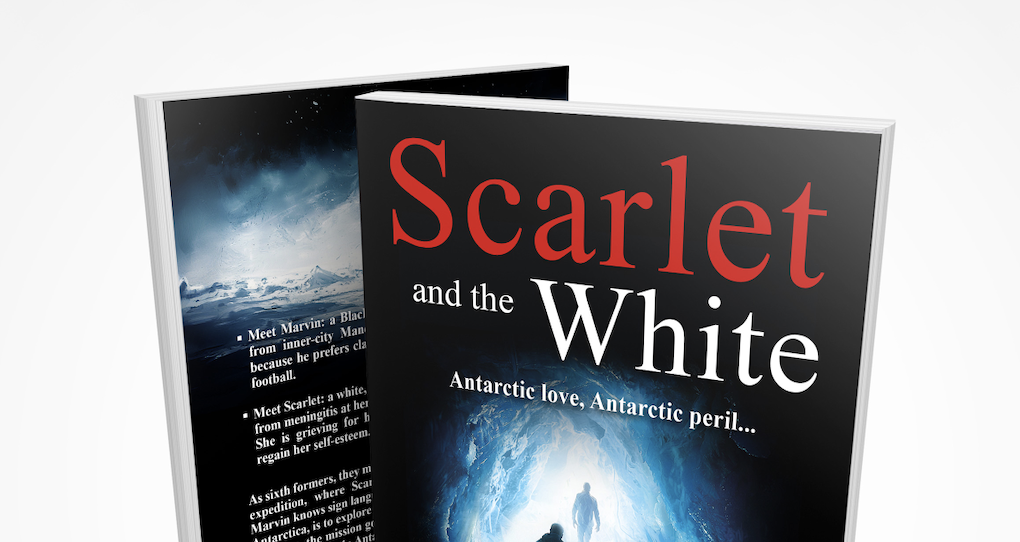
At its heart, Scarlet and the White is a gripping thriller. Set against the stark, unforgiving landscape of Antarctica, Michael Fellowes – who we previously interviewed here – has crafted a story packed with suspense, danger and emotion.
While deaf representation is woven throughout the novel, it’s the strength of the storytelling that draws you in from the very first page.
The novel follows Scarlet, an 18-year-old who recently became deaf after contracting meningitis, and Marvin, a thoughtful, neurodiverse teenager from Manchester. Their paths cross on a scientific expedition to Antarctica, where an already challenging mission soon turns into a desperate fight for survival.
It’s an intriguing premise that quickly gathers pace, making it difficult not to become invested in what happens next.
One of the book’s greatest strengths is its characters. Fellowes takes time to develop them as individuals, giving each their own personality, fears and motivations.
I found Scarlet’s journey particularly compelling as she comes to terms with losing her hearing and begins to rebuild her confidence, while Marvin’s quiet determination and kindness make him a likeable companion.
Their relationship develops naturally throughout the story, creating a romance that feels believable and that which tugs at the heartstrings, especially as the danger surrounding them intensifies.
(I won’t reveal any spoilers, but I will say that I found the ending of the book particularly heartbreaking for the couple!)
I thoroughly enjoyed the descriptions throughout the story as Fellowes has a wonderful eye for describing both visual settings and internal worlds too.
Whether Fellowes is capturing the hostile beauty of Antarctica or describing Scarlet’s internal world, his imagery painted vivid pictures for me without ever slowing the pace of the story.
I was especially struck by the way he conveys Scarlet’s experience of tinnitus and sensory overload. These moments felt authentic and immersive, as they offered readers a glimpse into her world through carefully chosen descriptions rather than lengthy explanations.
And I have to emphasise how much I appreciated the way that deafness is woven so naturally into the narrative. British Sign Language, cochlear implants and different communication preferences are simply part of the characters’ everyday lives.
Fellowes never pauses the story to educate readers or explain every detail. Instead, these elements become part of the fabric of the novel, allowing the deaf and hearing characters to exist alongside one another in a way that feels refreshingly genuine.
As a deaf person and BSL user myself, I particularly enjoyed this approach. Scarlet is not defined solely by her deafness, nor are the deaf characters reduced to stereotypes. They are fully realised people whose relationships, choices and resilience drive the story forward.
That’s what makes the representation so effective—it feels authentic because it simply belongs.
Scarlet and the White succeeds because it never loses sight of what readers want most: a compelling story. It delivers suspense, adventure, memorable characters, moments of tenderness and an emotional core!
If you’re looking for a page-turning summer read, Scarlet and the White deserves a place on your reading list.
Michael Fellowes has written an engaging thriller with heart, and I thoroughly enjoyed the journey.
Scarlet and the White by Michael Fellowes is available to purchase from Amazon.
Review by Rebecca A Withey
Contact Rebecca at rebecca@withey.com if you have something you’d like her to review.
Enjoying our eggs? Support The Limping Chicken:

The Limping Chicken is the world's most popular Deaf blog, and is edited by Deaf writer and photographer Charlie Swinbourne.
Our posts represent the opinions of blog authors, they do not represent the site's views or those of the site's editor. Posting a blog does not imply agreement with a blog's content. Read our disclaimer here and read our privacy policy here.
Find out how to write for us by clicking here, and how to follow us by clicking here.
This site exists thanks to our supporters. Check them out below:
- Lumo TV: TV programmes in BSL for the Deaf community
- Bellman & Symfon: home alerting solutions, including the mobile phone transceiver!
- SignVideo: Instant BSL video interpreting online
- British Deaf Association: Working to transform the way BSL is accessed in the UK
- 999 BSL: call 999 in an emergency, in BSL
- Deaf Umbrella: Making colleges and workplaces more accessible
- Appa: Looking for RSLIs, TSLIs and CSWs, apply here!
- Signly: Adding BSL to websites
- Signworld: Learn BSL online!
- DCAL: world-class research into deafness, cognition and language
- Lipspeaker UK: specialist lipspeaking support
- BID: Deaf services, including advice and support, interpreting, employment and letters
- Interpreting Matters: BSL interpreting agency
- Sign Solutions: Instant access to Interpreters, training and BSL translation nationwide
- InterpretersLive: On demand BSL video interpretation
- Performance Interpreting: BSL interpreting at concerts
- National Deaf Children's Society: The leading charity for deaf children
- Action Deafness: “A Deaf-Led Charity” – interpreting & community support services




Posted on July 30, 2026 by Rebecca A Withey